
Identifying Value Pockets in a Startup Draft
Kemper Trull highlights some of our tools to show you how to extract maximum value in dynasty startup drafts!
By Kemper Trull · 5/6/2026
It’s startup draft season, and I feel sorry for your “real” jobs. A slow startup draft demands March Madness levels of attention, between the board strategy, the frenzy of trade offers, and the hilarity of the chat. I would wager that GDP takes a solid 80% dip this time of year.
So, for something substantial enough to tank the global economy, it’s critical that you get your draft strategy right, and that means knowing where the value lies in your draft.
Know Your League
First things first, you need to familiarize yourself with your league’s scoring and roster settings. For the sake of this article, we’ll stick to a relatively standard format of Superflex (2 QB), Tight End Premium, starting 1 QB, 2 RB, 2 WR, 1 TE, 3-4 Flex, and 1 Superflex. Half-point PPR would favor the RBs a bit, whereas full-PPR props up the WRs.
If you get the chance to choose your draft slot via a derby process, I really like the 10-12 slots for a 3RR (third round reversal) draft. In this case, you’d start with the 1.10-1.12 and 2.01-2.03, and then you’re at the front of the pack the rest of the draft, after the reversal (3.01, 4.12, 5.01, etc.). I’m of the opinion that there are a clear 12 players in the top tier, so you’ll have an opportunity to acquire an anchor player in the first round, regardless of draft position. These “stud” players for me are:
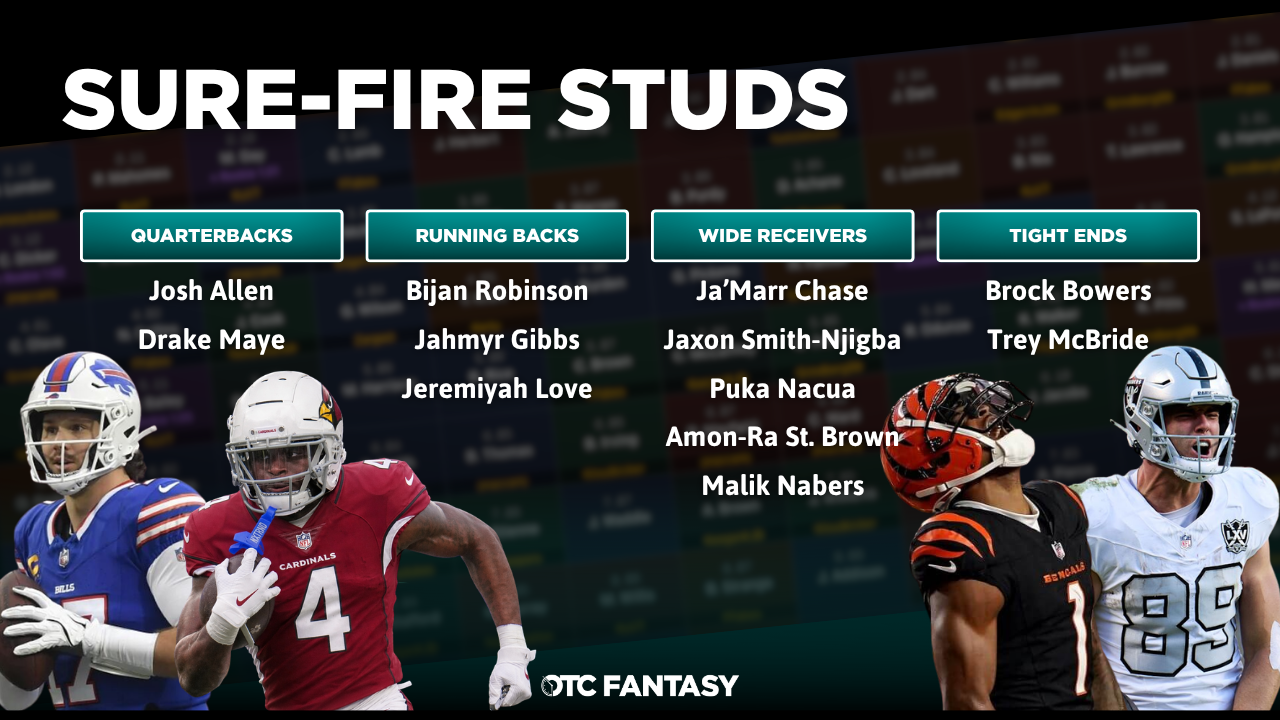
Quarterback: Josh Allen, Drake Maye
Running Back: Bijan Robinson, Jahmyr Gibbs, Jeremiyah Love.
Wide Receiver: Ja'Marr Chase, Jaxon Smith-Njigba, Puka Nacua, Amon-Ra St. Brown, Malik Nabers
Tight End: Brock Bowers, Trey McBride
I think these players give you a positional advantage every week and are valued as such by ADP. However, for the sake of this article, trading out of the first round can yield a lot of excess capital later in the draft, and there are enough arbitrage plays available in Rounds 2-5 to make it worth considering.
Navigating the OTC Startup ADP Tool
To begin, let’s head over to OTC’s trusty Startup ADP tool. The rankings will include Rookies, so if your startup draft uses Kickers as a placeholder for 2026 rookie picks, this data should track pretty closely with your draft. If you do a separate draft order for rookies, you’ll have to manually back them out to adjust ADP.
From my experience, and judging by the ADP data on OTC, there is a clear cutoff on predictable fantasy production starting in the 6th round. We’ve got Marvin Harrison Jr. at 6.01, Brian Thomas Jr. at 6.04, and Jameson Williams at 6.10, just to name a few of the more polarizing players in this round. I’m not willing to lose out on the surefire production of a first-round pick in order to grab two or three of this caliber of player.
However, there is a large value pocket of arbitrage players starting in round 2 and lasting until the beginning of the 6th. And that’s where we are going to stack our picks. You can get an idea for some trades that have already gone through in leagues across Sleeper by checking out the OTC Trade Database. This tool rocks. You can choose your exact pick in the startup (Startup 1.06, etc.) or you can generally see deals that have included a "Startup 1st." Click "Configure Search" to add your pick to Side A and see some historical comps for your pick. You can also see the most traded players and picks to get an idea of what the market will be for each of your picks, should you choose to pick and trade later.
A couple of trades I love from the OTC Trade Database:
1.02 --> FOR --> 2.07 + 4.07 + 2028 1st round pick
1.08 --> FOR --> 1.12 + 2.02 + 4.07 + 4.12
1.12 --> FOR --> 2.06 + 3.01 + 3.03
Ideally, if you move off your first-round pick, you are picking up three later startup picks. As much as I love Trey McBride (1.12) in these TEP formats, if I could trade him for Caleb Williams (2.06), Justin Herbert (3.01), and James Cook (3.03), I’m doing that deal 100 times out of 100. To stick with the arbitrage theme, I would take Colston Loveland over James Cook with the 3.03 pick, in this instance. And the reality that Justin Jefferson, CeeDee Lamb, Lamar Jackson, and Jonathan Taylor are now “arbitrage plays” makes trading out of the first even more appealing.
Sticking and Picking
If you want to keep your first-rounder, no sweat! It’s a great player. There are still plenty of opportunities to acquire multiple picks in the value pocket. For instance, I also like these deals later in the draft:
3.12 --> FOR --> 5.05 + 6.03
3.02 --> FOR --> 3.11 + 5.02
3.06 --> FOR --> 5.10 + 6.03
Ultimately, you're looking to add two A- players for an A player. The perception is that you are giving up a lot in order to drop back two rounds, but the reality is that the first five rounds of the draft are chock full of studs. You can drop from James Cook (3.03) to Chase Brown (4.04) to Kyren Williams (5.08) and still get an RB1. Think about if you could trade James Cook for Chase Brown AND Kyren Williams. That's what happens when you drop back early in the draft.
Later Value Pockets
If you make it to round 7 or so and realize you have a Contender build, there is another value pocket for older, productive vets in Rounds 9-11. Here’s where we will find Terry McLaurin (9.09). Davante Adams (9.11), George Kittle (10.05), David Montgomery (10.08), Courtland Sutton (11.02), and Mike Evans (11.05). From my experience, Managers tend to overindex on youth during startups, so these productive vets fall much later than their production would warrant. You may only get one more year out of them, or you may get three more years, but that's also true of RJ Harvey (7.07), Bayshul Tuten (8.09), and so many others being drafted multiple rounds before these vets.
Early in your drafts, you’ll likely see Managers stick within 5-10 spots of ADP as they draft. Once your draft hits around the Round 10 mark, you’ll probably notice that teams start deviating from ADP to “get their guys.” This makes the ADP data a bit less reliable. There are some nice value picks with Round 14 ADP, but they may not make it that far in your startup draft. If they do, I like Dallas Goedert (14.01) and Tony Pollard (14.03) for a contender, and Jalen McMillan (14.05), and Brandon Aiyuk (14.07) as well in this range.
Ultimately, our goal is to maximize value and give you options to mitigate downside. If you are open to dropping out of the first round, you could be trading JSN for something like Justin Jefferson, Chase Brown, and a 2027 or 2028 1st. If you use the ADP tool correctly, you can unleash game theory on your draft and send shockwaves through the league.
Manage your rookie drafts with maximum efficiency using our Draft Tool! Seamlessy move between your draft lobby, the trade screen, and our rankings right within our site to exercise your alpha today!

Author:
Kemper Trull is one of OTC's newest analysts focusing on dynasty content. Be on the lookout for more of his written work, and catch him on some of our livestream content on Youtube!