
Pillars Of Dynasty Bestball
Everything you need to know to get started
By Jon Leonard · 7/15/2026

What is it?
Take your typical year-round dynasty fantasy football league, where you draft, trade, add/drop players, then you need to set your lineup ahead of the games each week. Bestball is like that, but no need to set your lineups, just focus on building the best team.
Think GM, not coach
Drafts, Trades, Waivers. That's your focus.
Any player on your team can hit your lineup any week.
Roster construction matters
Shoot for double the starters that your league requires. Need 11 starters? Aim for 22 players that can hit your lineup any given week as a minimum. Flip your roster construction compared to lineup. Load up on WR/TE, stick to QB/RB with starting or point scoring jobs. Strategies where you load up on backup QBs and RBs are for rebuilders in Bestball. As a contender, you want starters. The more opportunities the better. Volume can counter studs, so adjust your allocations appropriately. If you go studs at RB, you can make up at WR with volume and spike weeks. It's a balancing game. With a fixed size roster, you need to pick where to spend your resources. If you're on Sleeper, there's no IR or Taxi to save you either.
Sample Construction
Let's take a generic PPR league with 11 starting spots and a 26 man roster as an example. Make it 1 QB, 2 RB, 3 WR, 1 TE, 1 SF and 3 Flex.
Double the fixed positions. Your minimums are now 2 QB, 4 RB, 6 WR, 2 TE and then a dozen players left for the flexes.
Starting with QB, starters are gold. 2 is the absolute floor. Shoot for 3-5 here. You'll be contending with bye weeks and injuries, so having those extras is worth it. More than 5 can start to have diminishing returns, since you're taking away from other positions. Remember only 2 of them can hit your lineup. My ideal is 4 starters, but less is tolerable if you make up for it elsewhere.
RB up next. There's a hierarchy. Hit the starters first. They're going to anchor your RB room. Lean into the higher volume guys. After that, it's timeshare RBs. Find the guys with defined roles like in the passing game or at the goal line. They won't score as well as the bellcows, but they can fall into the endzone or PPR scam their way into your lineup. Lastly, high upside backups if you must. They're going to likely be zeros, but if you're short on RBs, maybe they find work. Aim for a total of 6-7 RBs with jobs.
TEs will depend on your scoring. If you've got a tight end premium, then by all means, treat TEs like WRs. Because TE is generally a thinner position, you can build a couple of different ways. Go thin with a stud and some lesser guys for depth, build around a handful of middling guys, or even go heavy with a bully TE room and load up. Feel out your league and keep an eye on the format. For me, I shoot for 4-5 of them, but you can be flexible. Yes, that's right, they can hit your flexes, so no need to go too lean, but don't go out of your way to acquire the midrange unless you're in a high premium.
Finally, the WRs. How ever many players you have left on your roster, fill it up with WRs. 10+ is totally fine. Grab the high upside boom/bust guys because when they hit, they're in your lineup. When they don't, someone else will be. Those guys that you avoid in lineup because they're unpredictable are great in bestball. Add in some higher floor players to anchor your team with some volume just in case you hit a real bust week. Prioritize the WR1 and WR2 on a team, but feel free to round out your roster with those deep threat WR3s and part time players. Chase the variance.
Be intentional with zeros
Because each of your players has a chance to hit the lineup every week, you want to limit the amount of players you have that are definite zeros. The backup QBs, backup RBs, buried WRs and the depth TEs are all unlikely to make it, so you need to be intentional with how many you carry. Bye weeks and injuries are going to hit and you'll need to work around them.
Trade future bye week players to your opponents, move injured ones for healthy ones, balance the zeros. You don't need to eliminate them, but you should limit them.
On the other side, if you're rebuilding, load up! Grab all the backup QBs and RBs. Trade for injured studs. Zeros are great when you're trying to limit your point scoring. It creates a really healthy league economy with teams going in opposing directions and natural synergies.
Waiver Churn
Allocate a spot or couple spots for roster churn so you can work the waivers. Much more of an edge to be active on waivers in bestball. If you don't have a minimum waiver bid, go nuts. Notice that the roster construction that I mentioned above was all approximate? Try to keep a couple of spots fluid so that you can work the waivers. Got a flex RB that isn't cutting it, ditch him. Some backup RB ascending because the starter is missing a few games? Pick him up and when the starter's back, toss him back to waivers. Catch and release fishing over here.
Check your league rules, can you drop players after games? Some leagues allow it and some don't. If you can and you really need a win, pick up Thursday players, drop if they stink, repeat for Sunday, repeat for Monday.
The Goal
Maximize your opportunity for points every week.
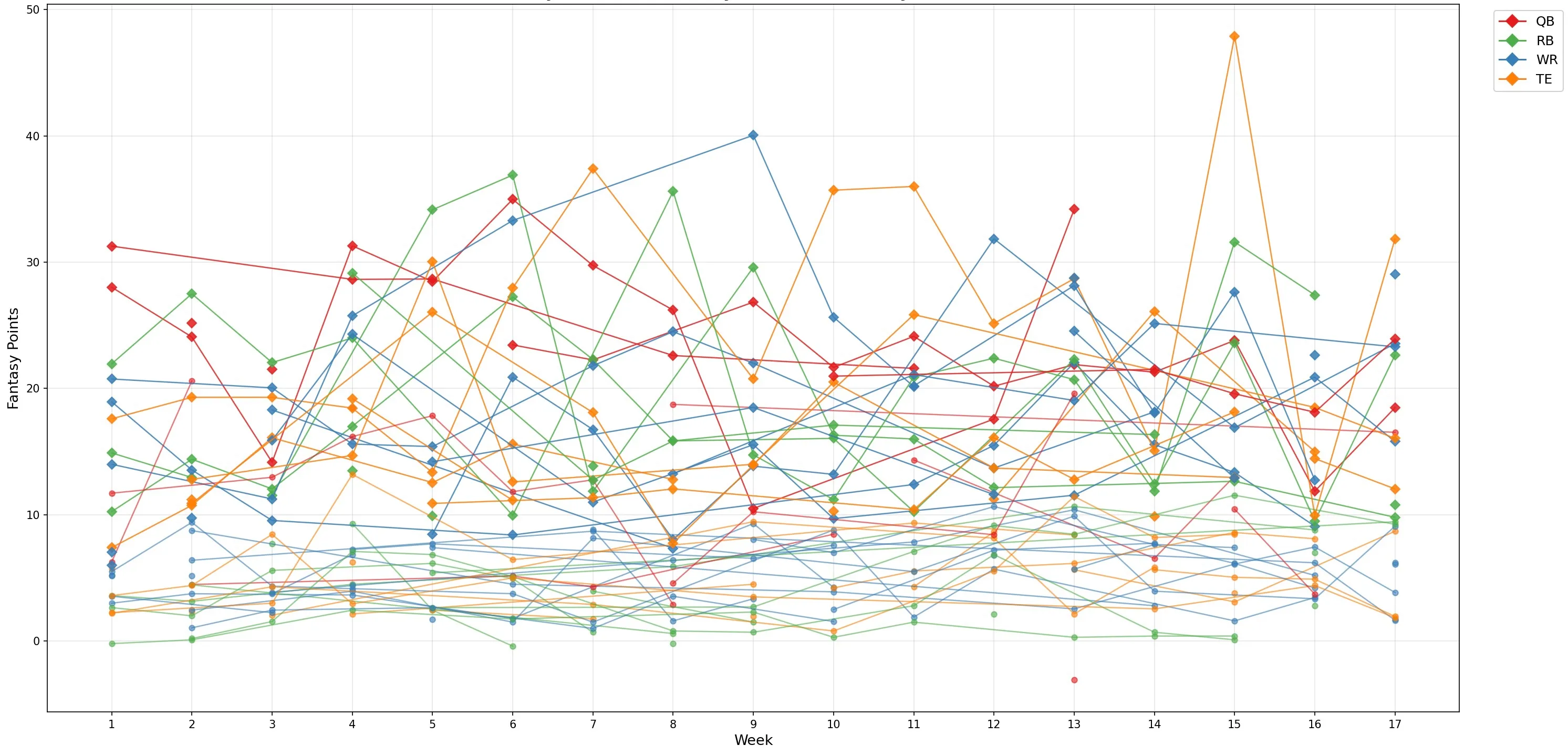
I ran an analysis on one of my leagues, a 12 team, start 12 Superflex Bestball PPR with 0.75 TE Premium and 0.25 added for 1st downs. The roster is 1 QB, 2 RB, 2 WR, 2 TE, 1 SF, 4 Flex and 18 bench. Over a full season that's 204 (12 starters x 17 weeks) starts that I'm trying to hit. This team ended up rostering 68 different players over the course of the season, with 42 of them entering the lineup at least once.
The chart's a mess, but that's a good thing. We're chasing those top dots every week and the bottom ones don't hurt. Unfortunately for me, I hit the wrong end of variance in the semifinals and rounded out the year in 3rd place.
Bestball means that you don't have to set a lineup, but it doesn't mean you have to be passive.
Work the waivers, make trades, dominate your leagues.