
Size Does Matter
Crash course on the differences caused by variations in league size and roster depth
By Jon Leonard · 8/4/2026
What does your league look like?
Many people have a base idea of a league in their head, something like a 12-team, start 10-lineup league. What happens when your league doesn't look like that? Your league settings drive scarcity, and depth drives value. A WR3 who can't crack your lineup in a 10-team league is hitting your lineup weekly in a 16-team league: same guy, same season, completely different asset. League size and roster depth put their finger on the scale when it comes to ranking and valuing players. Things to keep in mind when choosing a league. Time to look under the hood.
Do The Math
Take the number of teams in your league and multiply by the roster size, and you get the total number of rostered players. In a typical 12-team league with 10 starters and 16 bench, that's 12x26 or 312 players. Now take a 14-team league with 12 starters and keep the bench the same at 16. 14x28. We're looking at 392 players deep now. That's an extra 80 players that won't be available on waivers. Let that sink in. That's almost 7 rounds of extra players in a 12-team league.
More players rostered means that the waivers are barren. Deep leagues will drive a higher trade volume for replacement players, raising their value due to scarcity. Higher-end players are still difference makers. Check out the WAR graphs below.
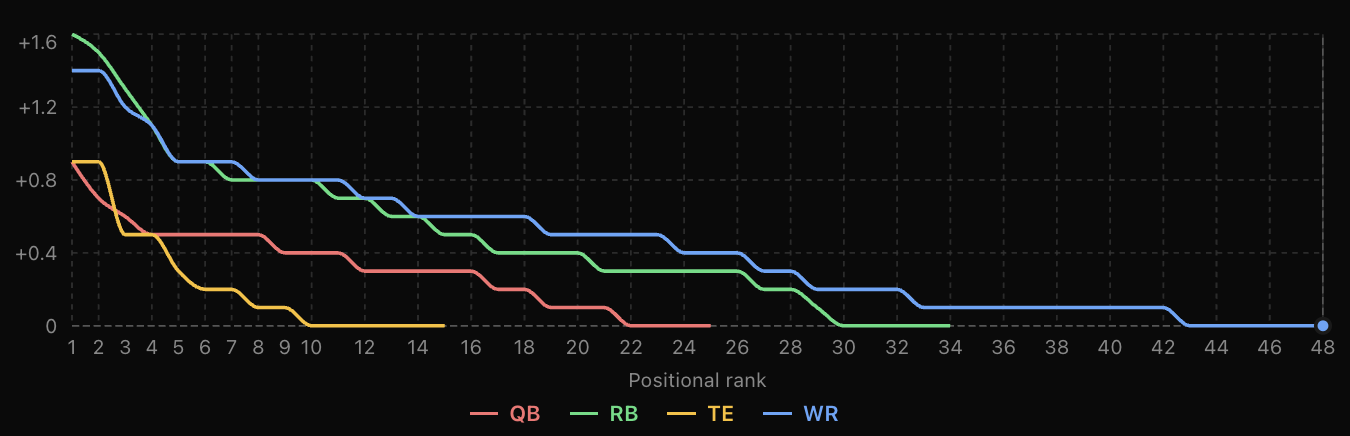
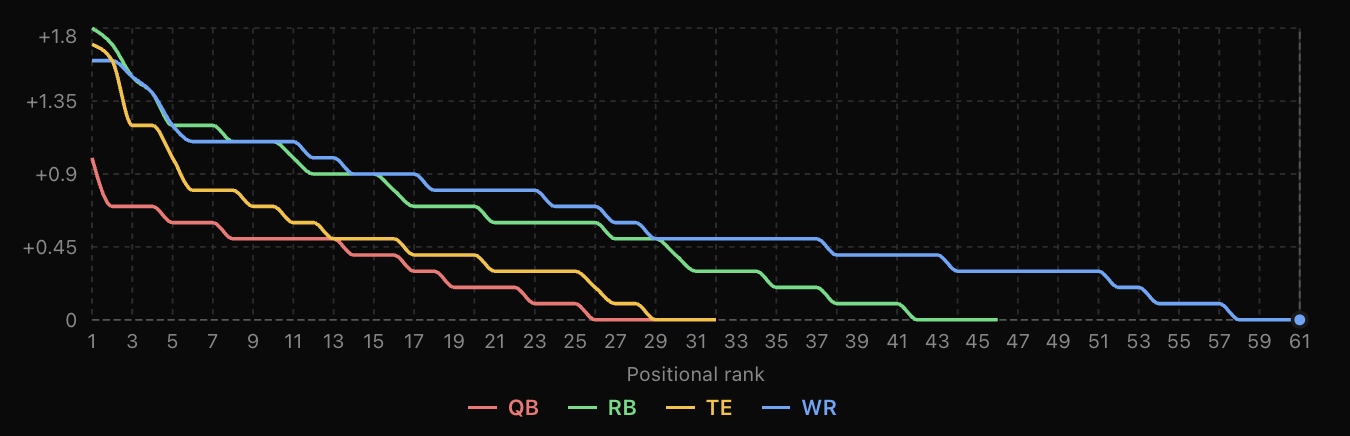
The graph above shows a 10-team superflex league with 10 starters. The graph below shows a 12-team superflex league with 12 starters, 2 TE spots, and a TE Premium. Don't worry about the order of the lines, but notice that they've gotten longer. The league depth shifted value because more players make an impact in the lineup.
On the other hand, notice the top-end players compared to the low-end. Studs are still difference makers and carry more weight than the depth pieces. Don't just split high-end assets because you need to fill more lineup spots.
League Size And Scarcity
The fewer the teams, the more important studs are and the more important it is to consolidate into them. In larger leagues, anyone getting meaningful touches of the ball has a purpose. That doesn't make the depth guys score any higher or become more important, but they become startable. They're now usable assets with some amount of value.
League size and starting requirements dictate the QB scarcity. In a 10-team superflex league, there are enough starting QBs for everyone to have at least 3. Jump to 16-team leagues, and each team only averages a total of 2 QBs. Draft and value them accordingly. QBX, hoarding, and similar strategies are more difficult to apply in 10-team leagues because there are enough QBs to go around.
The fewer total players rostered, the higher the value of the replacement player, the guys you can pick up for free. This also reduces the value of the depth players on your roster. Why pay for what's readily available? Smaller leagues and/or shorter benches mean more waiver activity.
Starters
As for any league, pay attention to the starting requirements. This could change the math on a 10-team league through added depth. A 10-team league with 12 starters starts to work similarly to a 12-team league with 10 starters if you add an extra superflex or 2nd QB spot.
The key takeaway from the starters is how many of each of the non-flex positions are needed. 1 vs 2 vs 3 RB or WR, for example. Fewer flexes and more position players will drive the depth at each of those specific positions due to the reduced optionality in builds. Deeper requirements will turn those mid- to low-end players into starters, even though the goal is still to maximize the points from each spot.
Bottom Line
That WR3 from earlier isn't good or bad on his own. It's all in the context. Ten teams, he's cuttable. Sixteen teams, he's in your lineup every week. The player didn't change. The league did.
The same math applies to everyone on your roster before you decide what a player's worth; please think about your league's numbers first. Number of teams. Starting requirements. Bench spots. Those four tell you how scarce a player actually is in your format, and scarcity is what you're paying for whether you realize it or not.
Stop valuing players in a vacuum. Value them in your league.