
Lessons Learned From a Scott Fish Bowl Noob
Scott Fish Bowl (SFB16) has kicked off and Kemper Trull gives their account on their first time in the biggest fantasy football tournament
By Kemper Trull · 7/11/2026
I finally made it into my first Scott Fish Bowl. After way too much time waffling over which video game league to join, I settled on Mike Tyson’s Punch-Out (Shout-out to Tecmo Bowl, Diablo II, Excitebike, Tekken, GoldenEye, Halo, and so many others!). I had my pick of draft spots, so I checked last year's settings and found that the leagues did a third-round reversal in SFB15. I love the 12-slot in a 3RR, so I jumped directly into the 12-slot of my league.
Then the scoring and settings were released for SFB16. And the format is NOT a 3RR.
First lesson learned: Wait on scoring/settings before selecting your draft position. 🤦🏻♂️
The scoring this season is a throwback to a popular SFB of years past (SFB9), juiced for TEs in particular but offering huge bonuses for big plays. Every roster position is a FLEX, with 2 SuperFlex slots. You could feasibly draft all TEs or all WRs and have a chance.
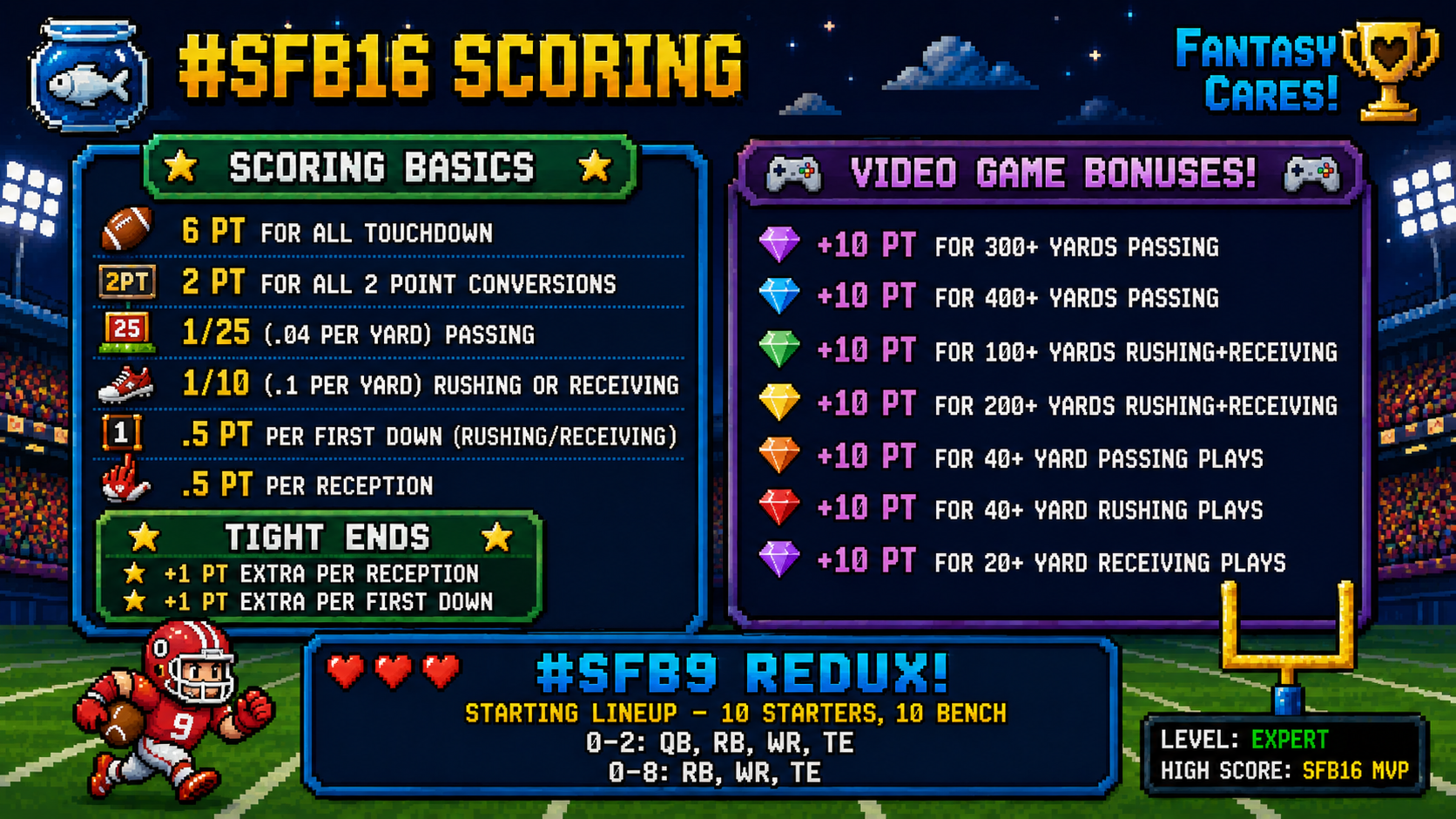
Leading up to our drafts, research revealed that there were 20x as many 20+ yard passing plays (1,551) as 40+ yard rushing plays (78) in 2025. So RBs were immediately dropped down my priority list. Looks like I'd be focusing on WRs and TEs early.
Once my league was active on Sleeper, I jumped to the Players page to review stats from previous seasons. It's hard to fully grasp how the scoring settings will affect players until you see the raw stats. There were many of the usual suspects until I saw George Pickens ranked #11 overall in 2025. The big plays. Edges to be found.
Second lesson learned: Find the edges and develop a strategy.
In my research on Sleeper, I found a curious contradiction: QBs were projected much lower than other position groups, yet also lower than their historical production. For example, Josh Allen was projected for ~450 points in this format, but he had never scored fewer than 600 points in any of the last six seasons. It may be that Sleeper has trouble predicting the bonuses that QBs receive (300/400-yard passing games, 40+ yard completions, etc.). I also saw several TEs and WRs projected WELL beyond any of their previous season highs in points scored (apparently, Jake Ferguson is going to score 500 points this season, despite never scoring more than 350 points in a single season).
Third lesson learned: Sense-check projections against past performance.
When the draft began, I assumed everyone credible enough in the industry to get an invite to this tournament would know the same things I knew. Boy, was I wrong. The draft ran just like any home league draft you've ever been in, with a few managers very clearly understanding where the value is, and many others sticking to tried-and-true rules (i.e., draft RB/RB in the first two rounds, get your 2 QBs early, etc.). I did not expect to see this many RBs and QBs taken this early...

The other thing that REALLY struck me was just how differently each league's draft boards played out. I was comparing my draft to several others in the OTC group alone, and each board was completely different. Obviously, you should expect some variance between leagues, but these were "all over the place" different. "Two and three round differences on particular players" are different. Did they not do the same research? Am I going to dominate my league?
Eh, who knows. Anything can happen in a season, and even if I stick to the strategy that best mirrors the league's point distribution, I could still lose if I back the wrong horses or get struck by the injury bug.
But speaking of point distribution, before my league even started drafting, I went to the league overview in OTC. I saw the "Scoring by Position" chart comparing the SFB settings to Default League settings.
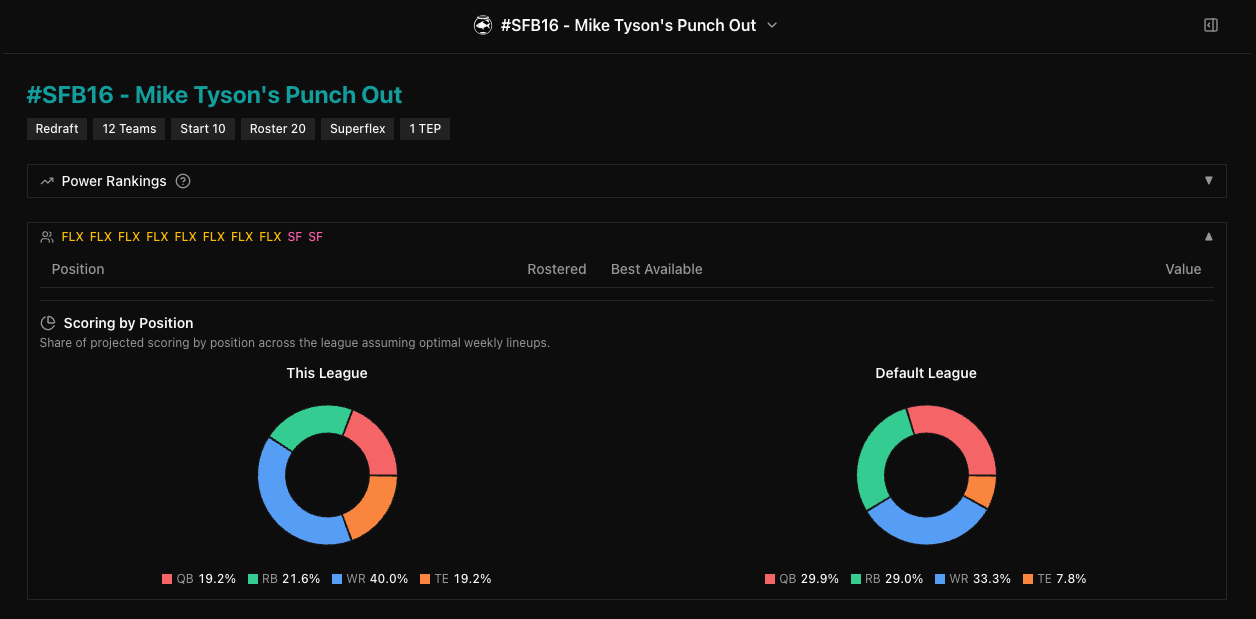
In a normal league, points are distributed fairly evenly among QB, RB, and WR (29-33%), while TEs account for only 8% of league points. In SFB16, WRs are juiced to 40%, and TEs are pulled even with QB and RB (between 19% and 22%). That's a MASSIVE indicator.
I used this data to compare it with the PAR charts for this specific league, which are also available in the OTC toolkit.
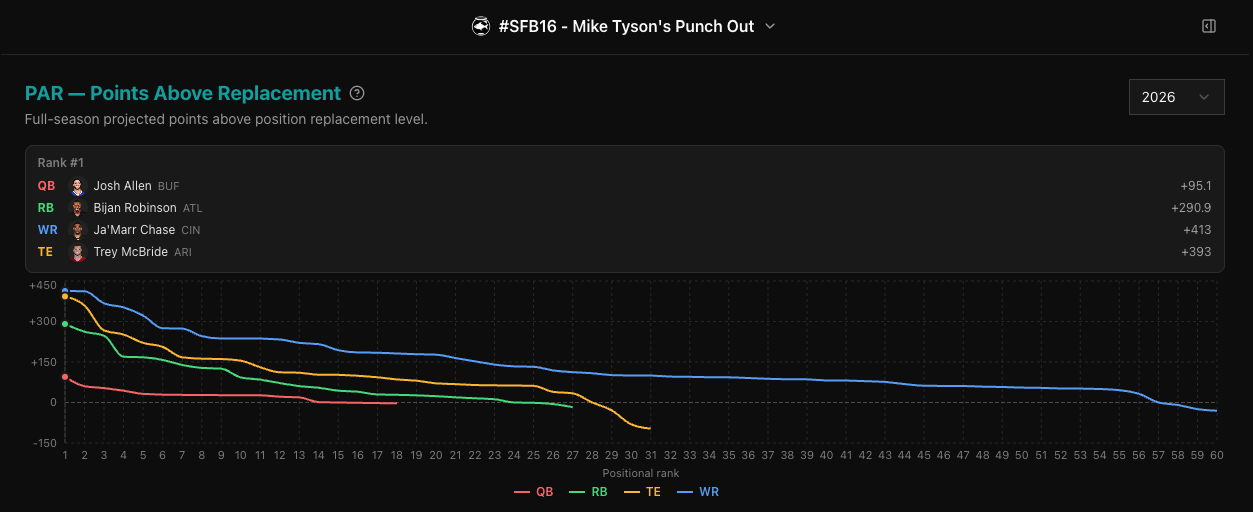
What I found there was a steep early decline in TE scoring, and the position turns negative PAR around TE30. Pretty similar story with RBs. QB scoring was much more even until about QB20, with minimal advantages at the top end. Load up on WRs, grab an elite TE early, and wait as long as you'd like on RB.
Because the QB projections on Sleeper are so unreliable (mentioned above), I decided to get two pocket passers for my SuperFlex later in the draft, and I’d be happy to punt RB until I started considering promising backups. Ultimately, you want to score points, so if I'm deciding between a 500-point QB and a 250-point RB to fill out my starting lineup, it's a pretty easy decision.
Fourth lesson learned: the OTC toolkit is freaking RAD.
I'll be sure to post updates here and on socials (follow me on X @kempertrull), but this Scott Fish Bowl experience has been super fun and also educational. One thing I know for sure is that there is a great community surrounding the event on nearly every platform. Check out the OTC Discord for lots of SFB chat and much, much more. And if you are in SFB16, or any other future rendition, remember these lessons:
Wait on scoring/settings before selecting your draft slot
Find the edges and develop a pre-game strategy
Sense check between projections and past performance
The OTC Toolkit is freaking RAD