
Scoring Matters
How changes in scoring settings affect your leagues and how you can adjust to take advantage
By Jon Leonard · 10/1/2026

Different Leagues, Different Priorities
Dynasty leagues are all different, with a variety of scoring settings, bonuses, and penalties. In my last article about league variations, I discussed roster settings and how Size Does Matter. Here, I'll focus on how scoring affects league dynamics, how points are scored, and what that should mean for your priorities. Each setting also has thresholds where it starts to matter. Let's dig in.
QB Scoring
There are several ways to adjust scoring for passers: both positive (touchdowns, passing yards, and completions) and negative (turnovers, sacks, and incompletions).
Passing Yards and TDs
Most leagues with variations on touchdown scoring range from +4 to +6 for passing touchdowns. Sleeper defaults to +4, but we'll be using +6 in this article for reference.
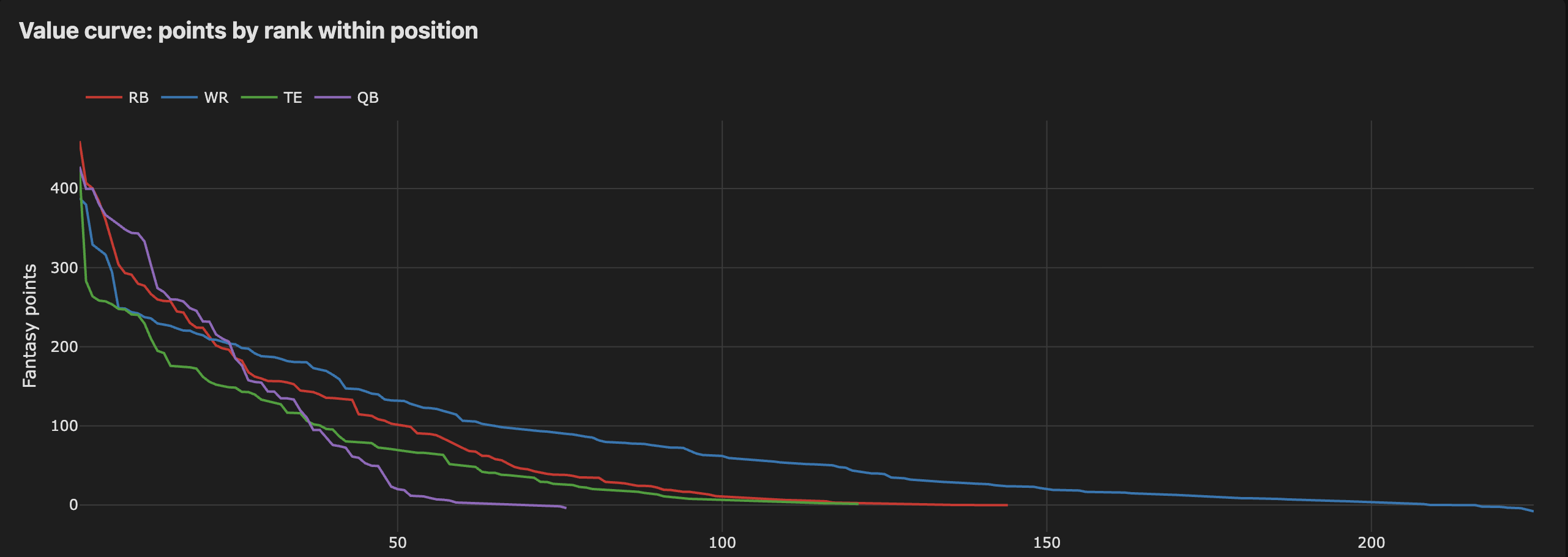
Below and throughout the rest of this article, you'll see curves comparing player scoring throughout a position using last season's data. Don't worry too much about the actual points or players, since those will change year over year; focus on differences in player profiles or changes in how positions score relative to each other.
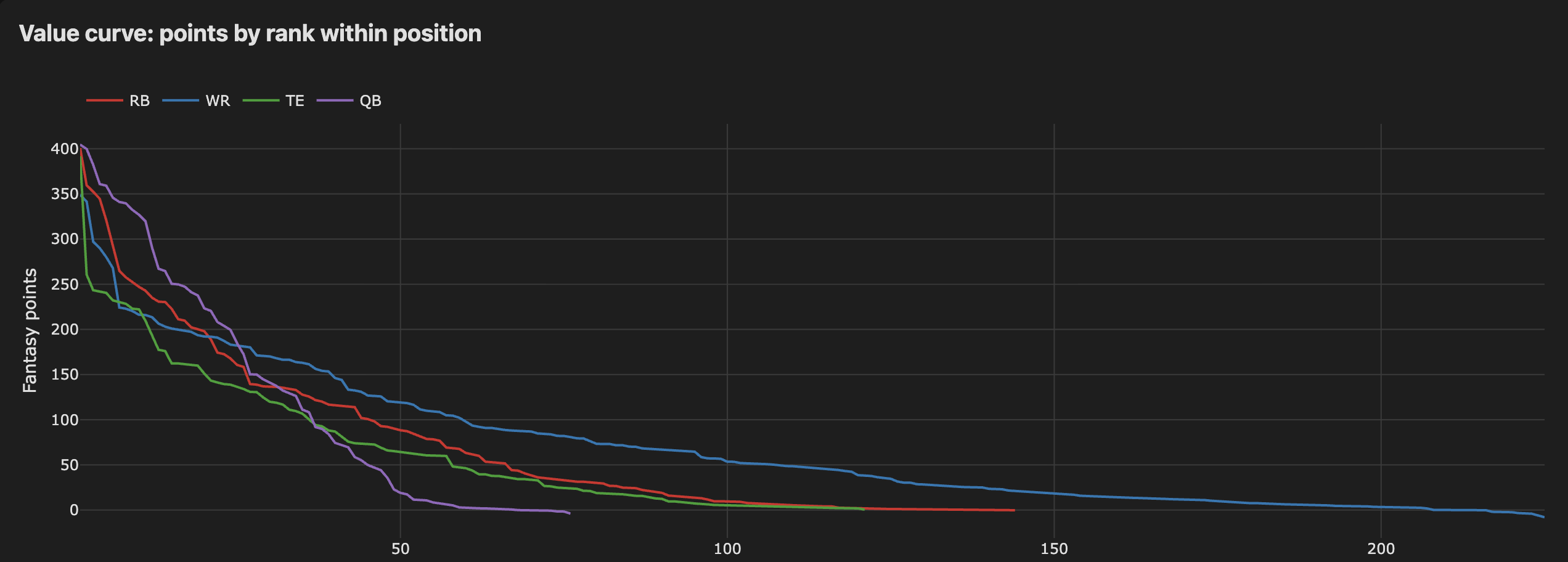
As we look at the impact of dropping the passing touchdown from +6 (above) to +4 (below), the change knocks the quarterback position down enough that it overlaps more with the scoring of the other positions. Not many leagues tweak yardage scoring, but if they do, it has a similar effect on QBs relative to other positions.
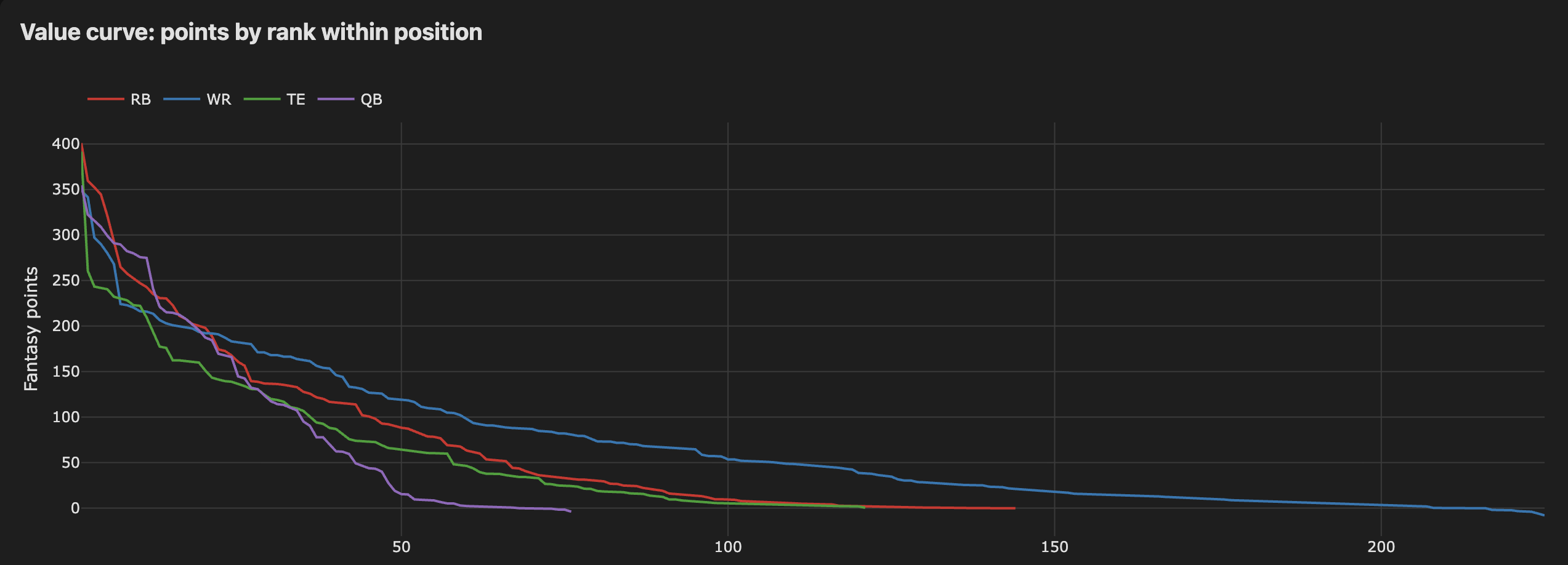
Notice that the top QBs drop by 40-50pts ( their TDs x 2 ). The rushing QBs and pocket passers shift based on the scoring change. Quarterbacks that run should get boosted in the 4-point passing touchdown leagues because they can make up for the lesser passing volume. However, the impact of that change can be overstated.
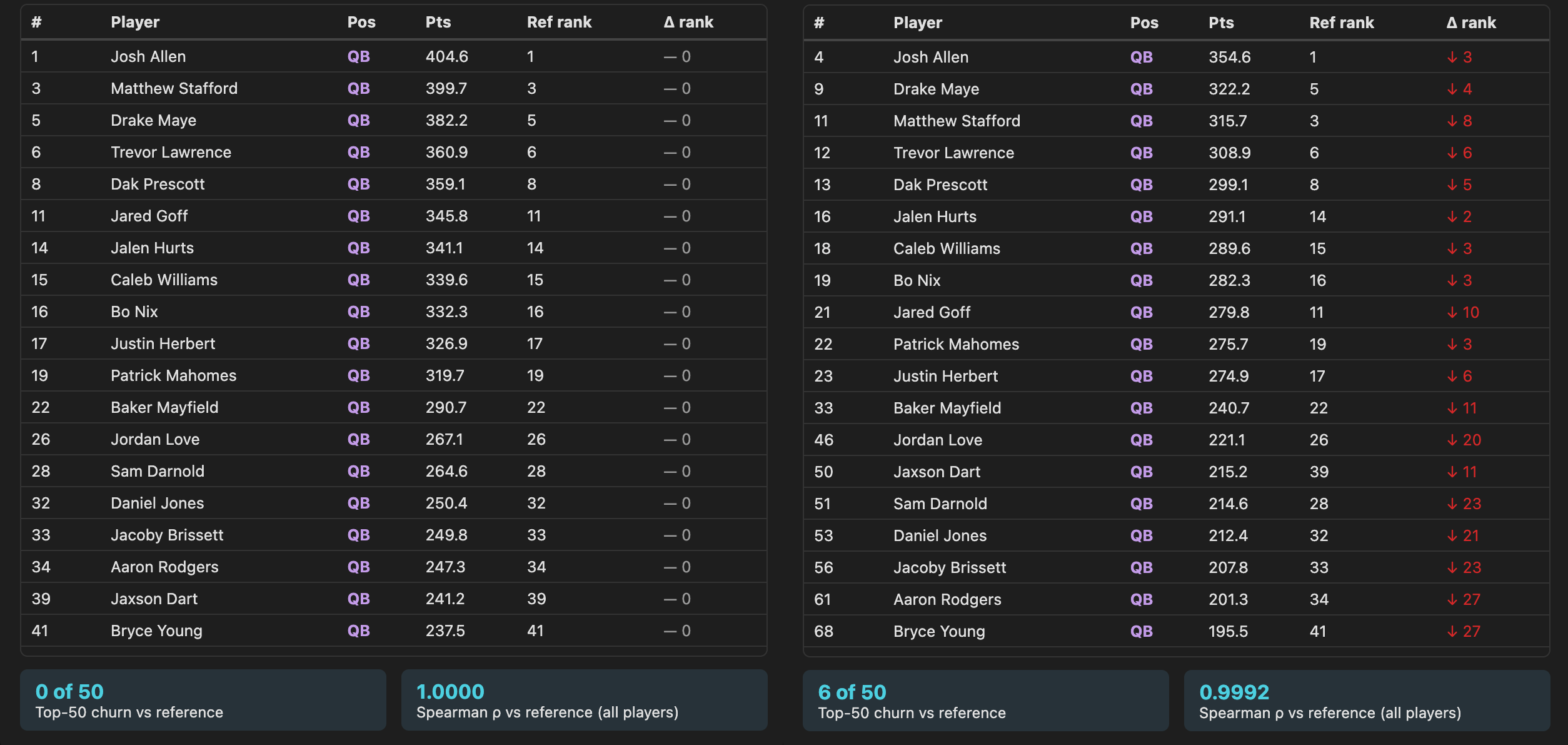
Within the position, it will shift players a few spots, but the bigger impact of touchdown scoring is on cross-positional value. Going from 6-point passing down to 4-point passing put the QB12 Baker Mayfield just over 2pts behind the RB11 Javonte Williams. If it were 6 points per passing touchdown, Baker Mayfield outscored Ja'Marr Chase.
Turnovers
This one is more about the penalties. They may be as heavy as -4 for an interception or as light as -1. Similar for fumbling the ball. There are even some leagues that give an extra penalty for giving up a pick-6 or fumble-6. The penalty's severity dictates whether you should avoid turnover-prone players. The impact on the position as a whole is relatively minimal, but within the position, there's a bigger shift for the interception-prone QBs.
Completions (or lack thereof)
Incompletion penalties and completion bonuses make these rules more about the differential. How many more passes are successful, and what is the overall volume? The caveat, it matters whether the bonus and penalty are even (+.1 / -.1) or skewed towards one side (+.1 / -.2). Your more accurate passers get a boost either way, but the distribution is the key.
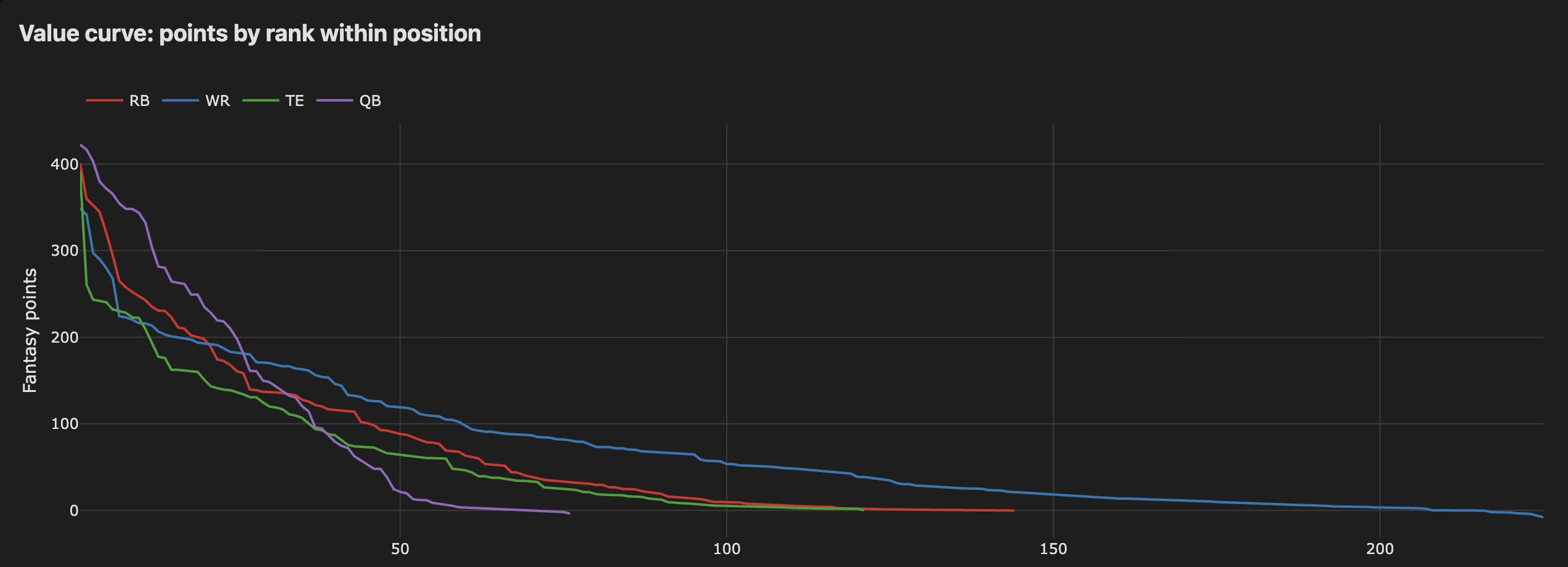
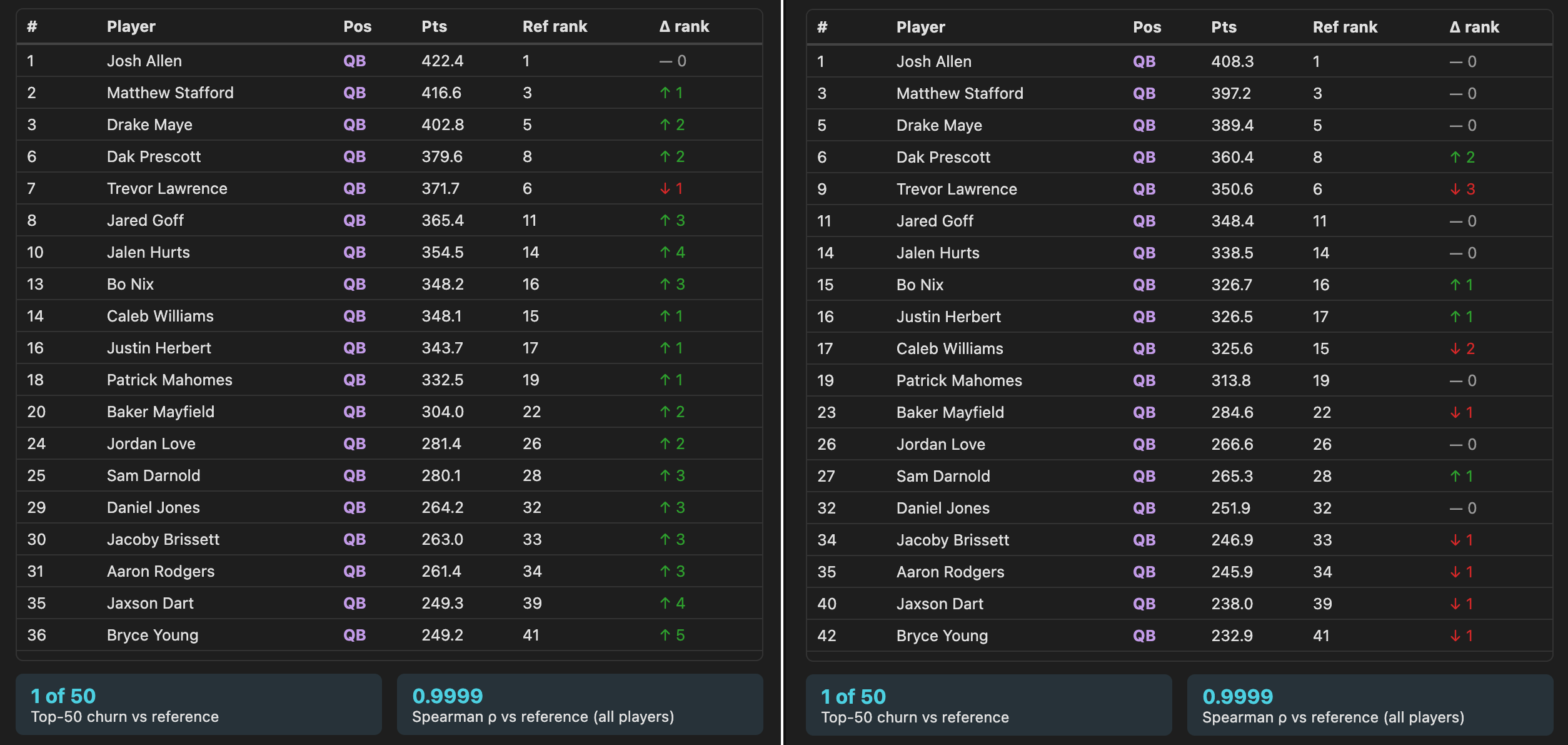
With balanced completion bonus/penalty, the passers overall get a little extra boost compared to that +6 TD scoring. When the penalty becomes outsized, inaccurate passers get knocked a little further down the overall ranks, but within the position, the rankings don't really shift. These scoring settings can be generally ignored when it comes to roster construction. Even in an unbalanced system with a poor passer that goes 10/30, it's likely only a 4pt loss. The bigger issue is that they only completed 10 passes and likely weren't going to help you anyway.
Sacks
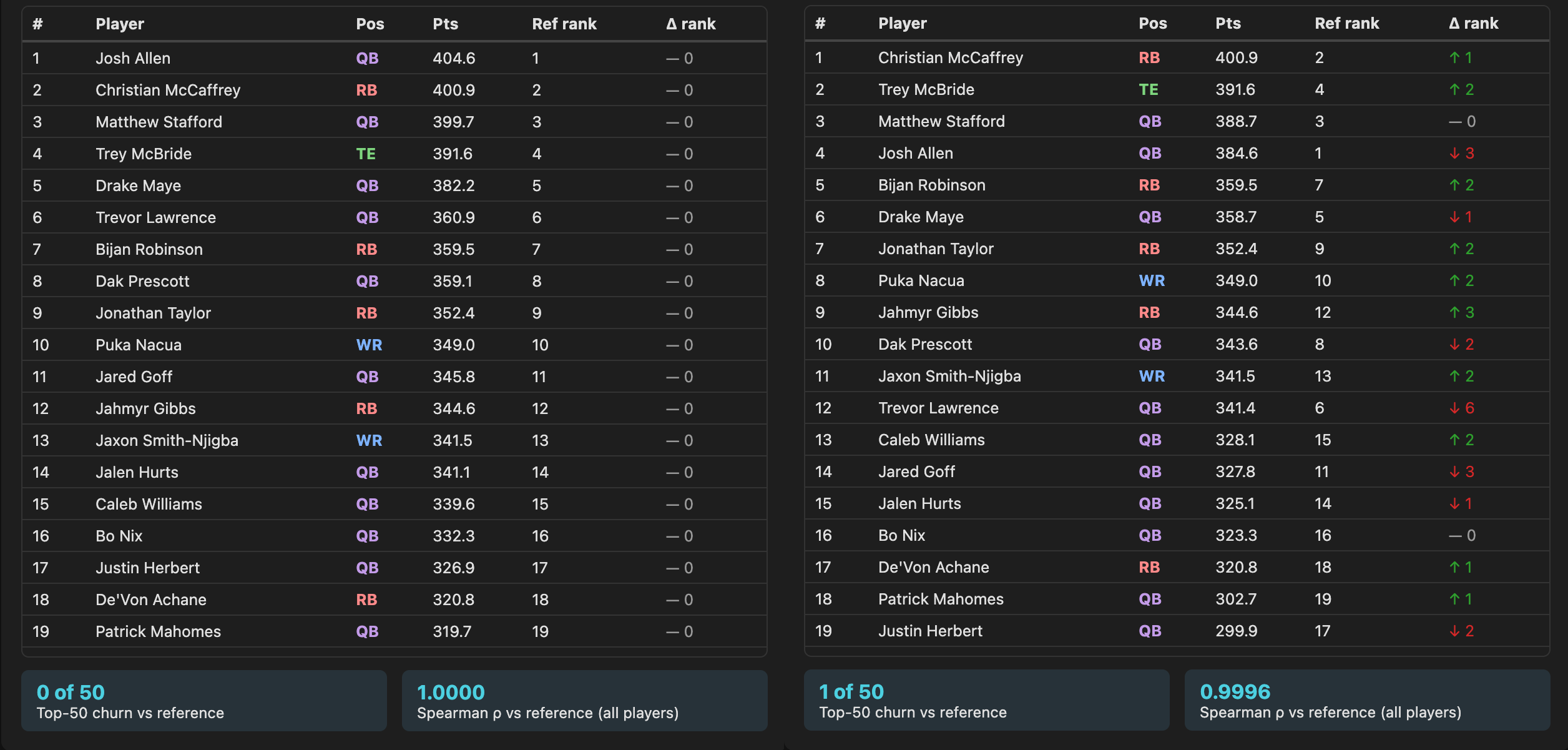
Purely a penalty, sacks kill drives and your fantasy team. For fantasy scoring, though, even at -0.5 penalty per sack, it only shifts players around a few spots. The position as a whole only shifted by about 20 points. It's not enough to try and predict year over year, but certain players suffer more than others. You should try to avoid QBs that take a lot of sacks anyway, but if they're penalized for it, steer clear.
Points Per Reception
My first fantasy league was "standard", which at the time meant that points came from yards and touchdowns, not receptions. Since then, the dynamic has shifted to favor PPR leagues. These come in a couple of flavors, with differences in how the points are awarded either for everyone or by position.
Half vs Full
At its core, PPR awards a bonus for each reception. The larger the bonus, the more the format emphasizes volume. Lower bonuses, including those in original non-PPR leagues, favor the big-play, high-yardage players and touchdown scorers.
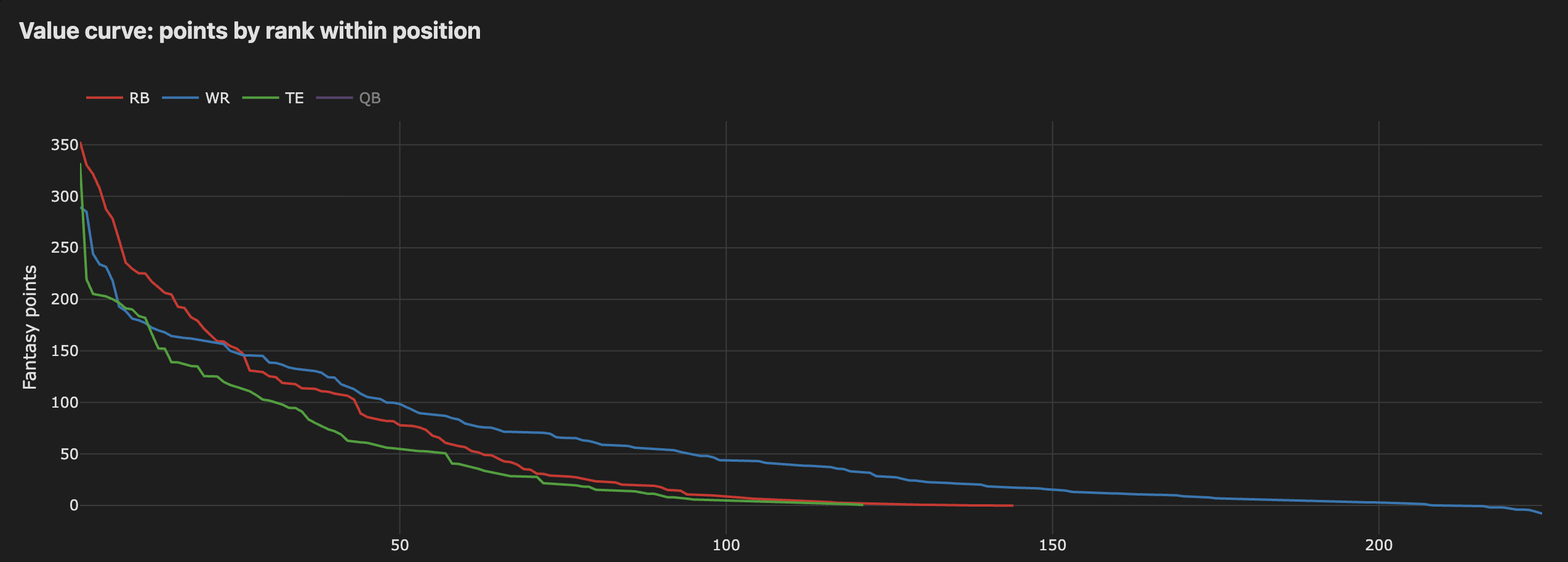
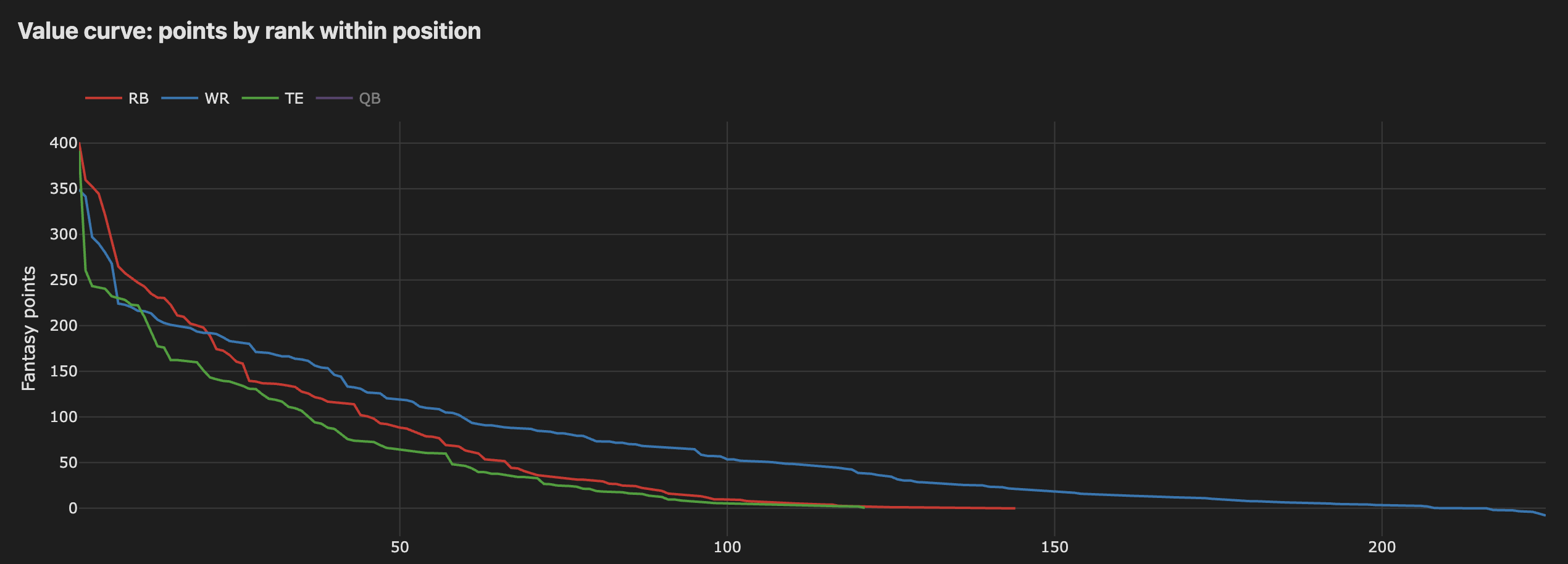
Adjusting points per reception affects not only pass catchers, but positional distribution as a whole. Adjusting the PPR from half (above) to full point (below) causes the positions to converge, even though RBs still lead the way. There's also an inflection point around the 24th player at each position in half PPR, but that rises to the 20th spot in full PPR. This is the point at which WRs start to outscore the RBs.
Tight End Premium
Historically the least impactful position in fantasy football, tight ends get a bad rap. In an effort to change that and get them to matter, the tight end premium was introduced. Giving TEs an extra bonus for receptions creates a bigger divide between the high-volume guys and the low-volume, touchdown-dependent ones, but it also raises the midrange into flex territory, depending on the premium. This typically ranges from +0.5 (not very impactful), +0.75 (starting to make a difference), to +1 or more (impactful). Over the next 4 curves, you'll see the shift from +0 or no premium, up through +0.5, +0.75, and +1.
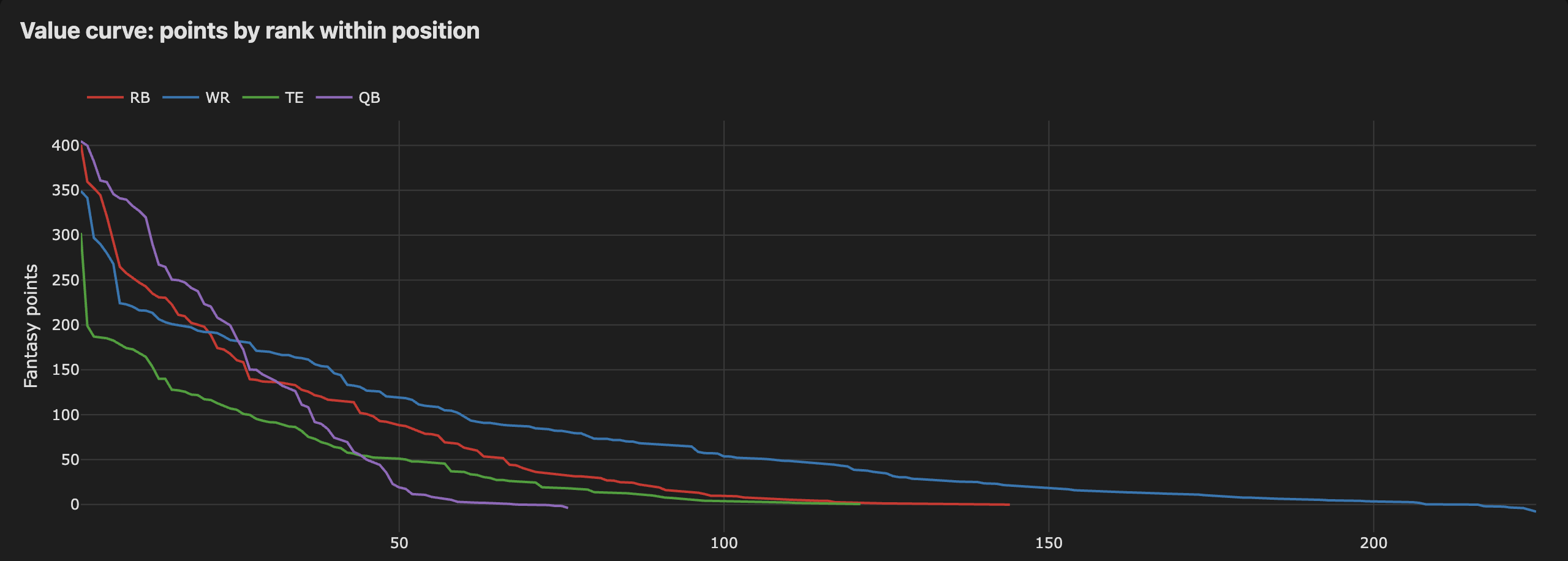
From no premium (above) to +0.5 (below), the tight ends are starting to rise, but are still quite low overall. There were only 2 in the top 40 overall point scorers. In this range, TE1s can fit into a flex spot, but unless you have multiple top TEs, there may be better options.
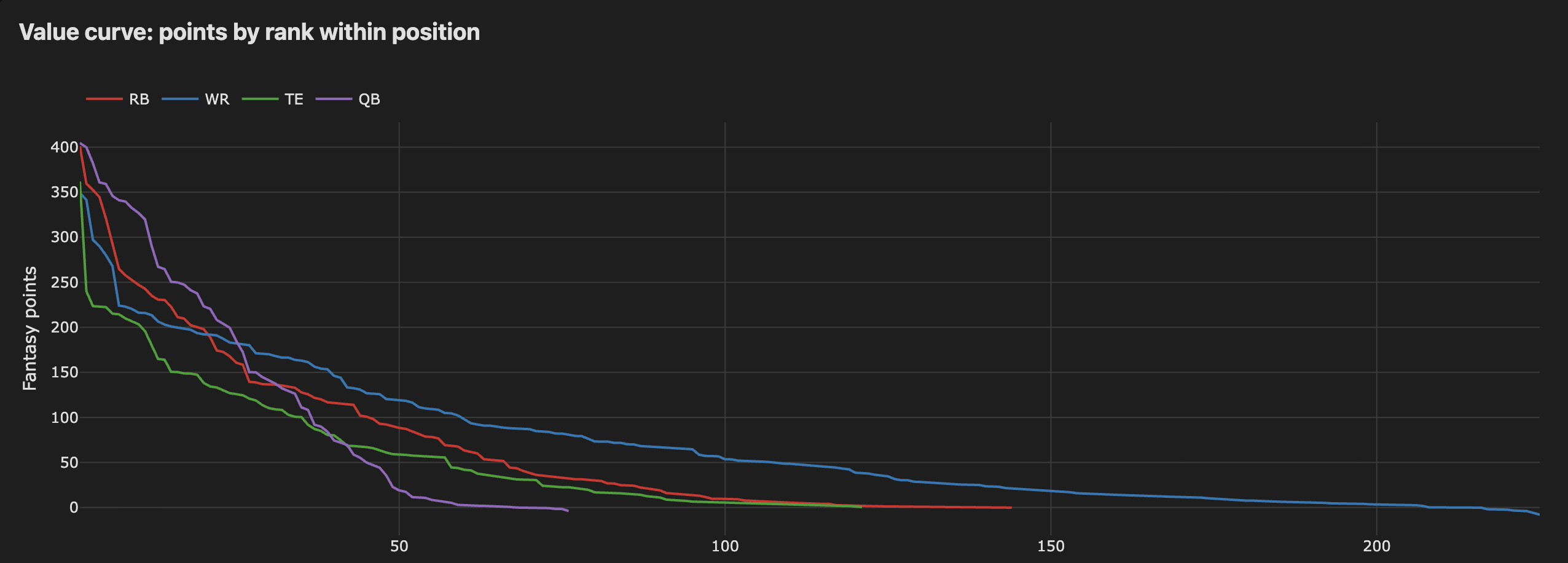
Moving to +0.75 (below) adds some meaningful intersections with the other positions. At this level, TE5 was a top-40 overall player. Depending on the player, even TE2s start to become viable flexes with enough volume. The touchdown-dependent TEs don't get as much help. Tight end premium is a volume bonus.
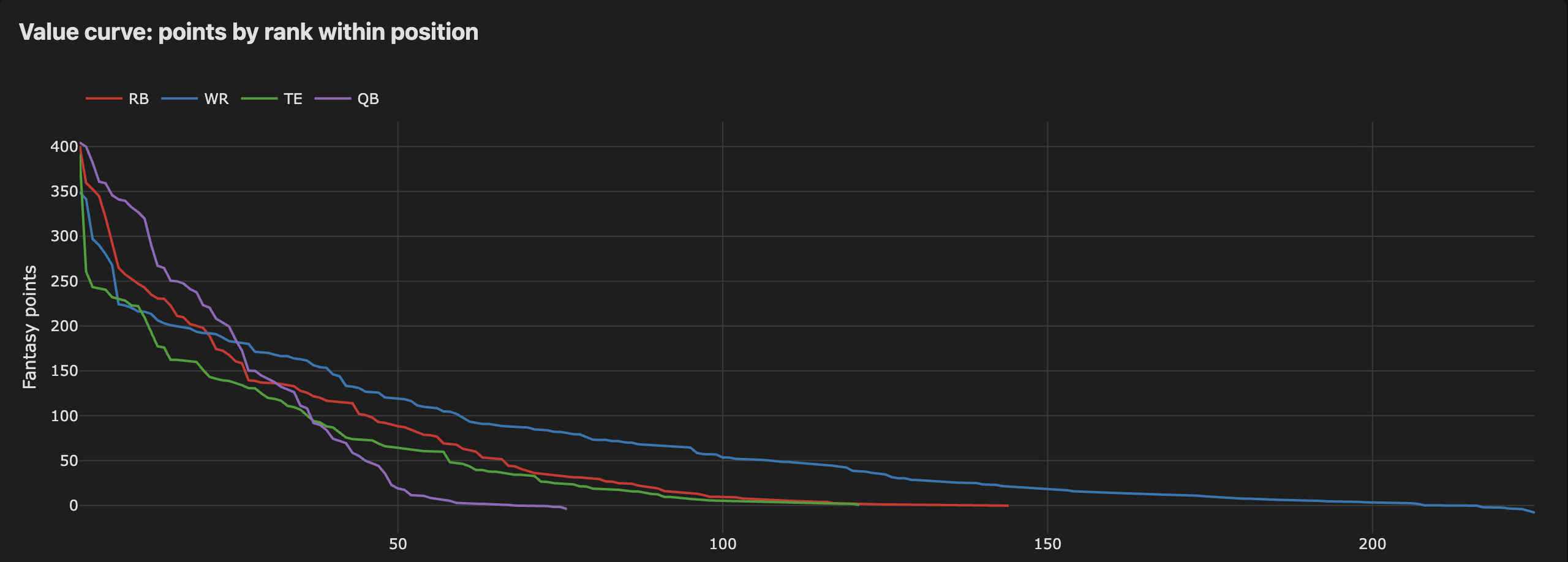
Finally, at +1 (below), the various positions really start to overlap. Once we reach a +1 premium, there are 10 tight ends in the top 45 overall players. Tight ends are now strong starts and valuable.
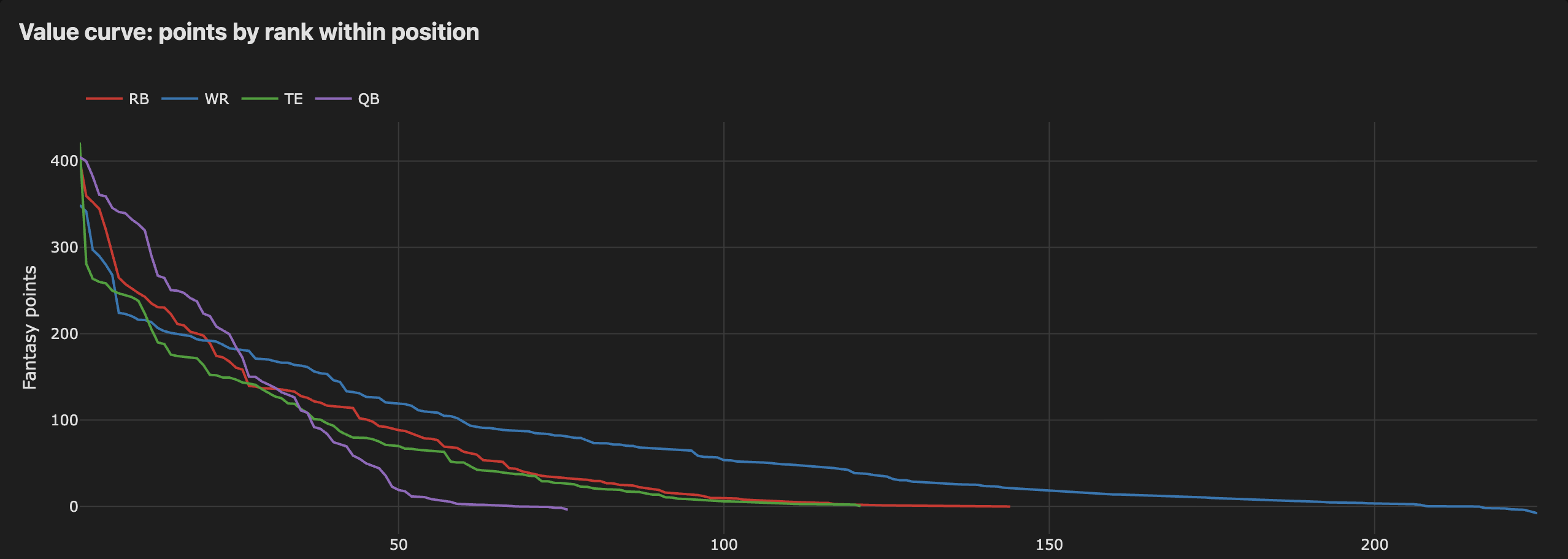
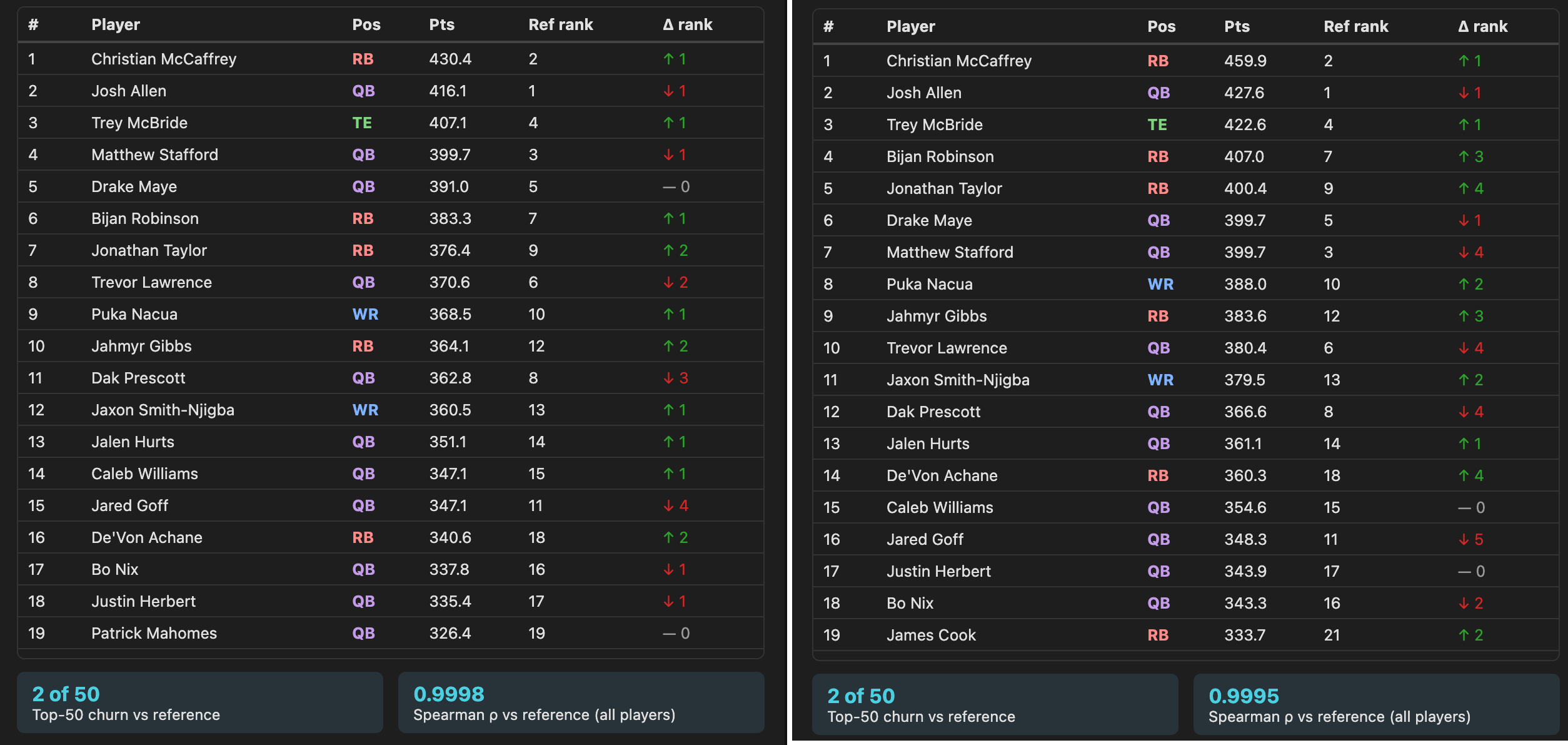
Moving to adding a +1 TEP was enough to bring Trey McBride from the 19th overall player to the number 1 scorer in this format for the given year. A premium of less than 0.75 is a good introduction to the option, but it won't heavily impact the game.
Tiered
Tiered PPR is a position-dependent bonus per reception. The effect here is to create balance cross-positionally between the running backs, wide receivers, and tight ends. These tiers typically look something like +0.5 for RB, +1 for WR, +1.75 for TE.
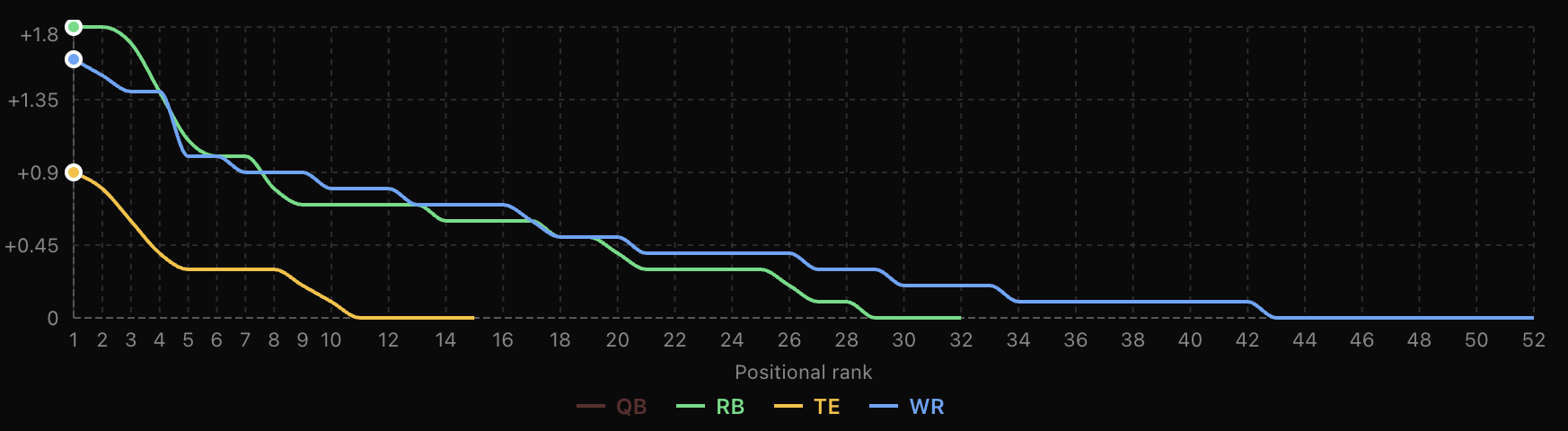
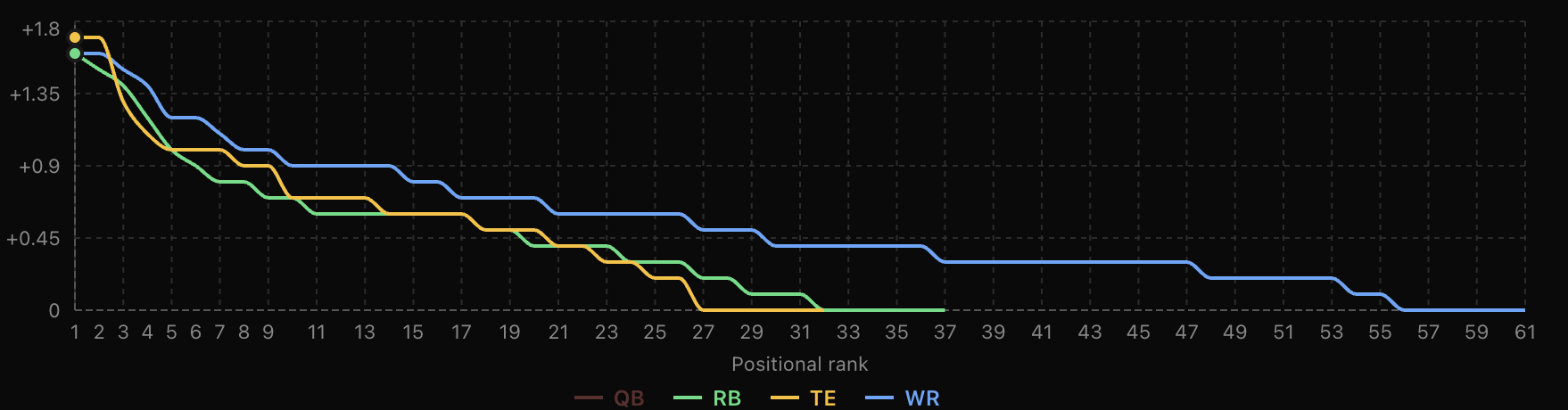
Above, you can see a typical PPR league's WAR chart, with RB and WR intertwined, while TE doesn't have nearly the impact. Below, you see the WAR for the example 0.5 / 1 / 1.75 tiered PPR. The TE is now right there with the RB, and more of them have become impactful players.
Points Per First Down
Awarding points for first downs adds an interesting wrinkle as well. This one is self-explanatory. Every first down adds an extra 0.25 or 0.50, whatever the bonus. This is frequently combined with half-PPR as an alternative to full PPR, leading to more balance across the non-pass-catching running backs and the receivers.
Adding +0.5 per first down (shown above and below right) is enough to prop up some of the higher-volume running backs and start to influence the rankings, while +0.25 (below left) has a limited impact.
Points Per Carry
Similar to points per first down, points per carry gives a boost to rushers. This is a pure volume bonus; the more carries, the better. Within the running back position, pure rushers get a bump so that they can compete with pass catchers. The extent to which this happens depends on the bonus. Let's take a look at the shifts.
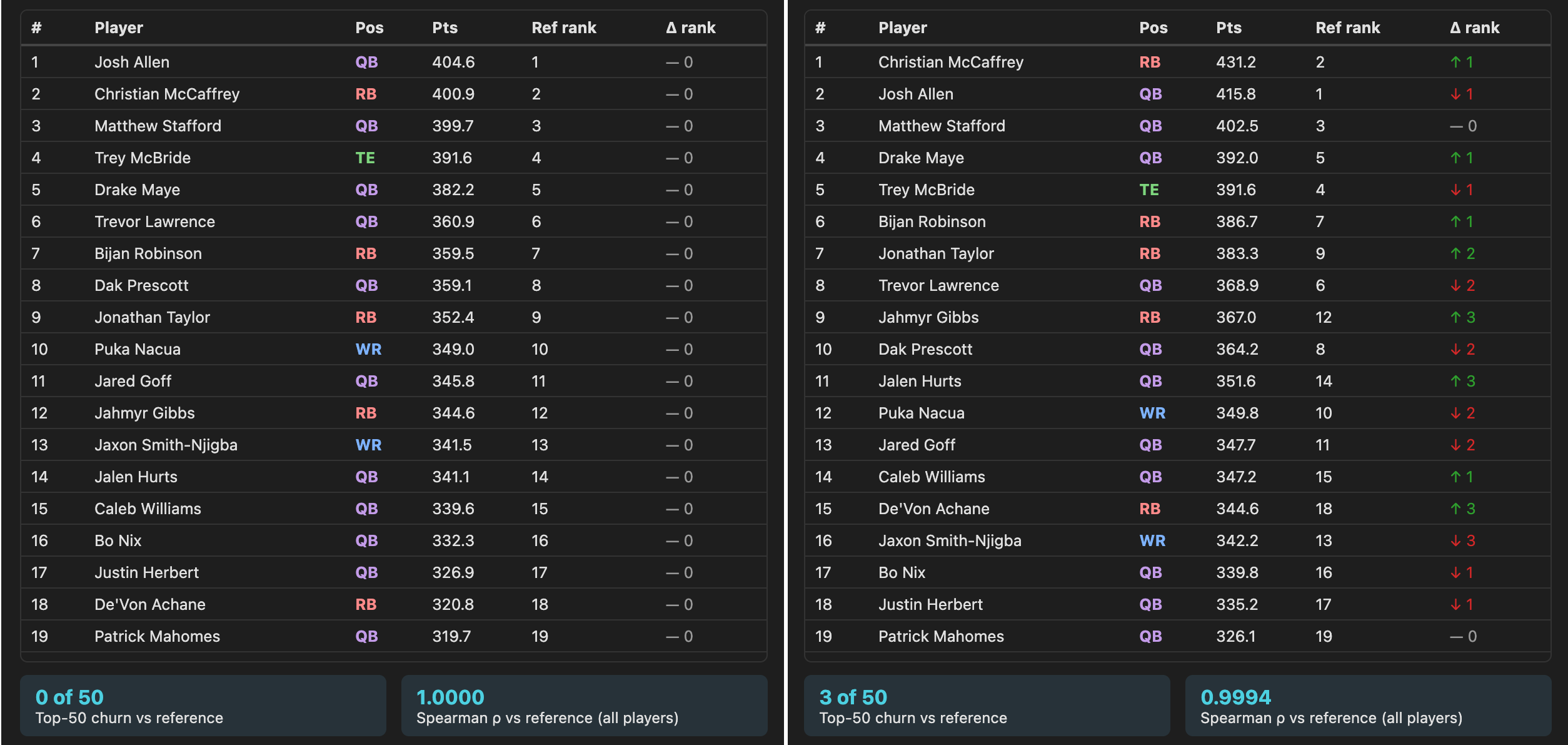
Above on the left is a stock league with no bonus for carries. To the right is a league with +0.1 per carry. Immediately, you can see the shift, bringing running backs up and pushing receivers down. The rushing QBs will also benefit, but not at the rate of the running backs. High-scoring receivers still remain in the top 20, but RB11 is now sitting almost even with WR6. This effect only gets amplified as the bonus goes up.
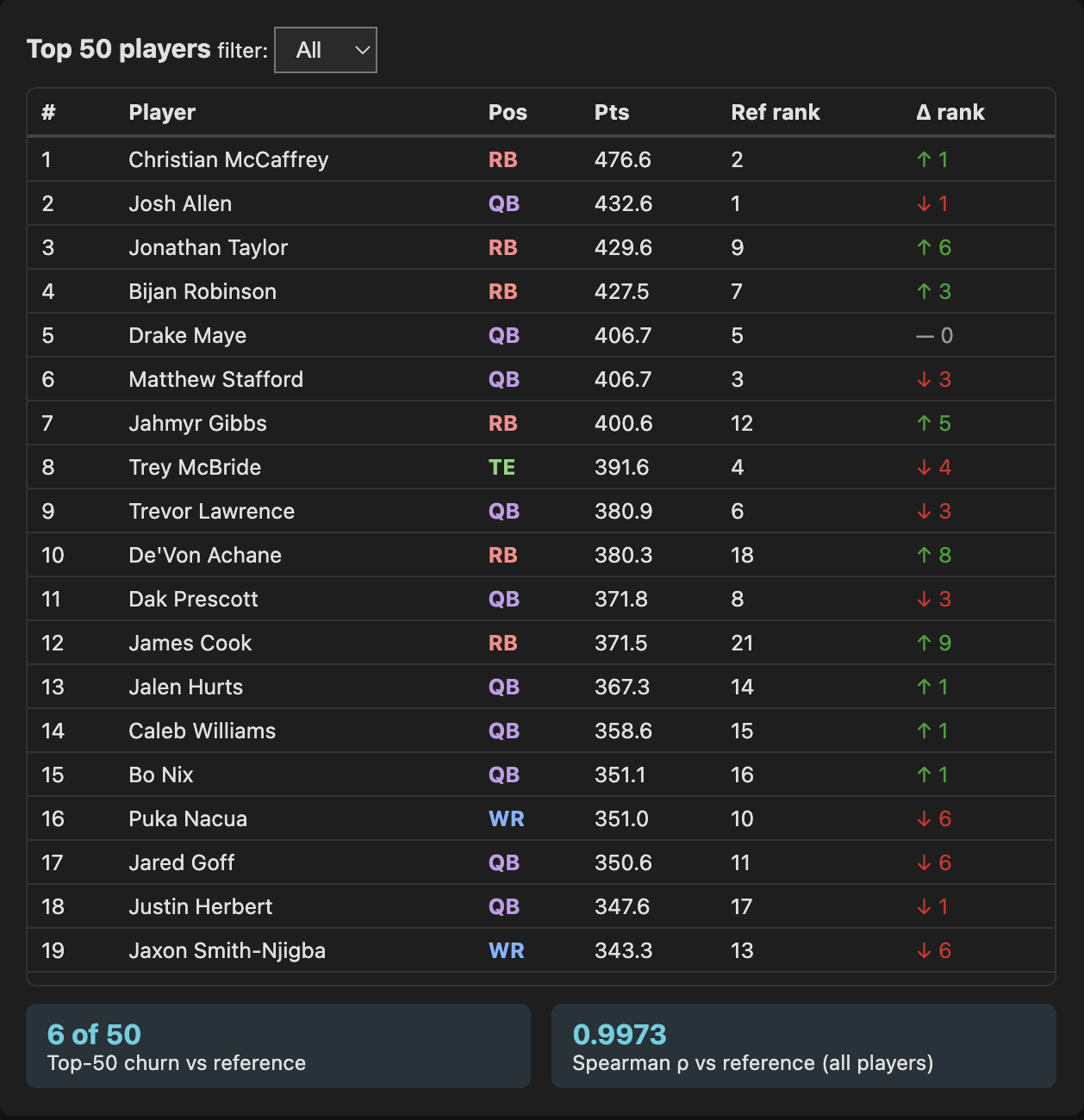
Shifting the scoring further to +0.25 per carry, you can really see the RBs crowding the top positions now, making up 3 of the top 5 and 5 of the top 10 in this particular imaginary league. RB13 Josh Jacobs is now outscoring WR4 Ja'Maar Chase. As I said earlier, don't worry about the specific points; it's the profiles and positions that matter here. PPC can really push running backs up the boards, so if your league includes them, don't underestimate the impact.
Return Yards
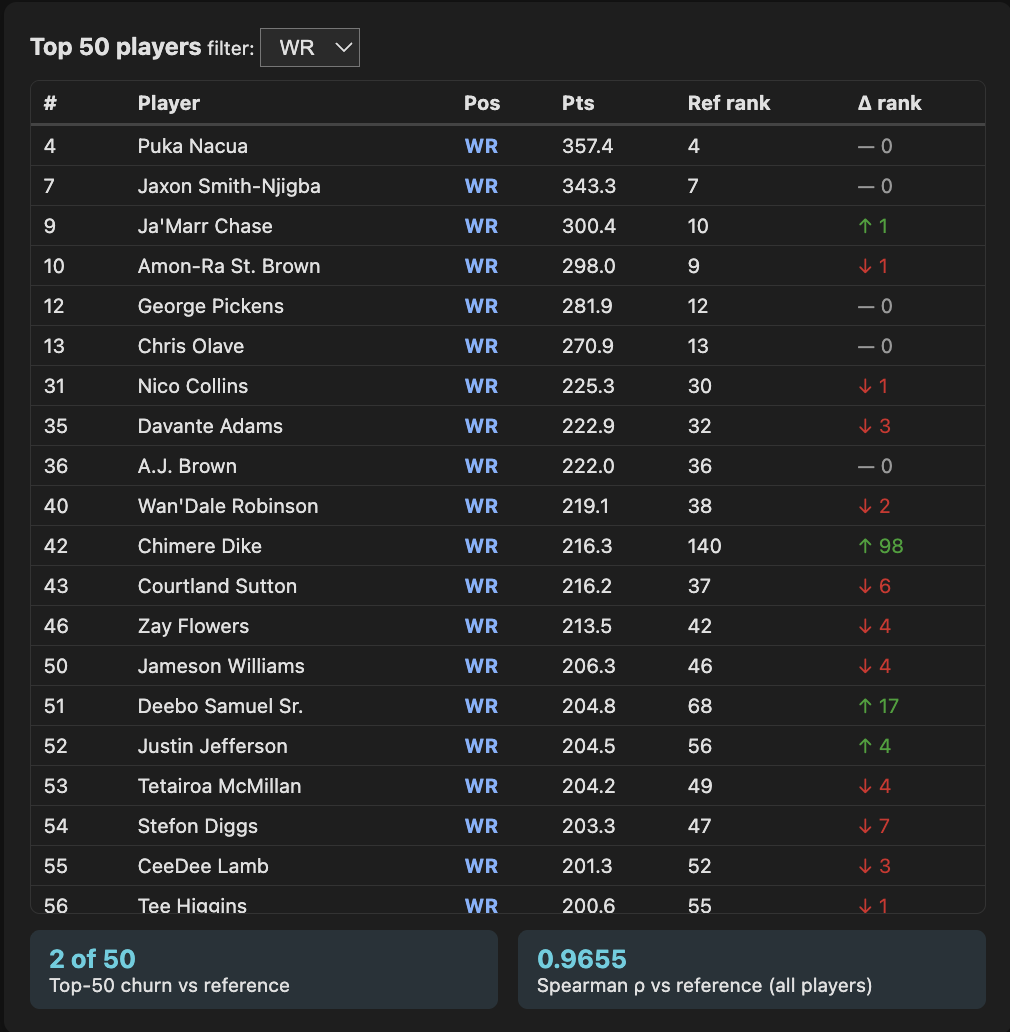
The vast majority of high-end returners are receivers, with a handful of running backs getting the job as well. The scoring setting makes all the difference in this format. At 10 yards per point, high-end returners will become starters and even finish top 12 in their positions. At 15 yards per point, they're still startable as flexes, but really need an offensive role to produce meaningfully. At 20+ yards per point, it's a nice bonus, but nothing to build around.
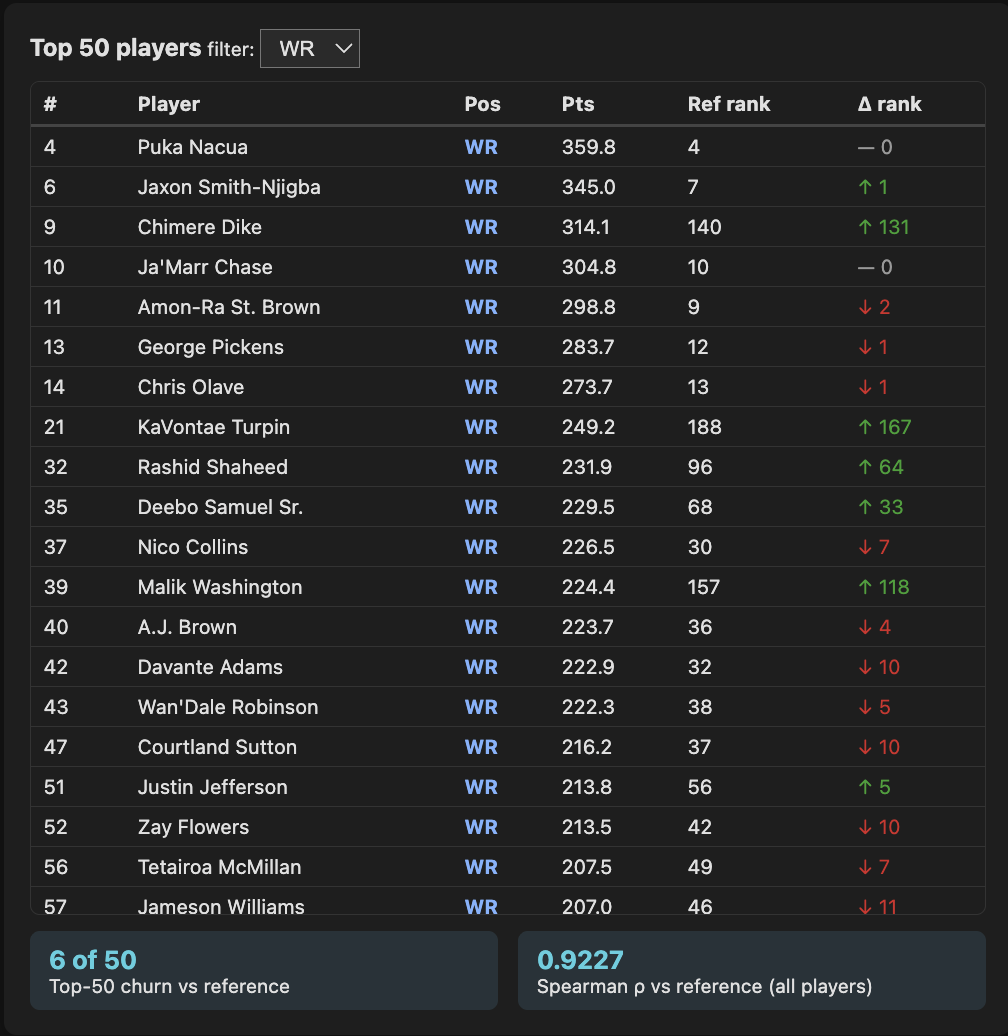
Above, we can see the impact that adding a point per 10 yards has on the scoring ranks, bringing Chimere Dike, KaVontae Turpin, Rashid Shaheed, Malik Washington, and Deebo Samuel into the top echelon of scorers.
Below is that same set of scoring, but with 20 yards per point. Chimere Dike and Deebo Samuel still make the cut, but the impact for the vast majority of players is dramatically lessened.
Putting It All Together
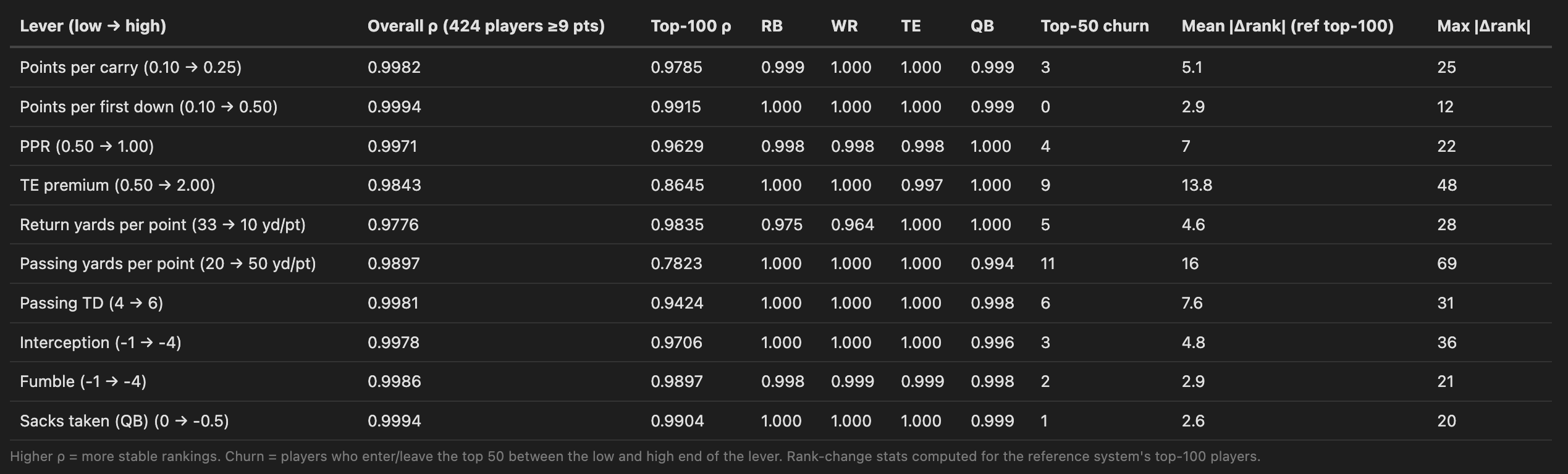
Each scoring setting affects the game in its own way. Check out the Top-100 p below to see the individual impacts they have on the top 100 players. Some, like points per first down and sacks taken, have minimal impact, while others, like tight end premium, points per carry, or return yards, can really alter the game. When these various changes come together, you can really find edges to lean into.
Now that you know about most of the various scoring variations common in leagues and how to adjust for each of them. Does your league have some of these, but not others or some combination? Are you looking to create a new league and adjust the settings? Start with the WAR Tool for your current league, but then head over to the Scoring Lab so you can adjust scoring and see how it'll affect the league in real time.